Thursday, February 17, 2011

Our Harmonium Comes to Life

Jeanine Snell and I had a quite lovely and unexpected experience this week. We were asked by Lynette Leach, visiting with her husband Athol from Williamstown in Melbourne, if she could please play the harmonium on display upstairs in the Pitcairn Norfolk Gallery. The harmonium was brought to Norfolk Island by Pastor Alfred Phelps and his wife Mrs Phelps in 1884. They brought it here for the new Methodist Church which was soon to be located in the Old Military Barracks. The harmonium continued to be used by the Church after they relocated and up until the 1960’s when they replaced it with an electric organ.

Lynette Leach playing our Harmonium
 As so many harmoniums and organs today are electric, there are not too people who know how to play one using the foot peddles and manually operating the stops. Lynette told us that she learnt how to play from her father who had been a Church Minister. Lynette, also a Minister at the Williamstown Church of Christ in Melbourne, has played piano from age five. The harmonium is in working order and as she clearly knew how to play we were pleased to consent to her request. The Pier Store was then filled with the amazing sound of this beautiful harmonium, as Lynette played well known Church hymns as well as the Pitcairn Anthem, Gesthemane and Oakleigh. It was a very special and quite emotional experience hearing the harmonium being played and to hear those hymns by Driver Christian, George Hunn Nobbs and Gustav Adolph Quintal reverberating through the Pier Store. In a cabinet beside the harmonium sits the tuning fork owned by George Hunn Nobbs, which was then passed to Driver Christian and then Gustav Quintal. The playing was a powerful reminder of the strong musicality and musical legacy left by not only these men, but so many Pitcairn Islanders and past Norfolk Island generations.
Mrs Phelps

Pastor Phelps from the book "Gathering Jewels"
The story of the Phelps’ and their bringing of Methodism to Norfolk Island was not without controversy. Pastor Phelps was an American Methodist missionary and he and his wife arrived on the island specifically to start up a Church. They began meetings in the home of Parkin Christian and within a few months held their first gospel temperance meeting. However there was great opposition to the starting of a Methodist Church including protests by angry crowds. This resulted in Chief Magistrate Arthur Quintal taking the unprecedented action of swearing in special constables to keep the peace. He said “on account of the numerous uproars and outbreaks of violent deeds between the Church people and the Phelpites I was obliged to adopt severe measures to prevent it, by drawing a line of distinction between the parties with strict orders to refrain from using abusing language against each other”. The congregation grew and within two years they had converted the Old Military Barracks into a church. The opposition did not stop and in 1888 a petition signed by 55 adult male members of the community called (unsuccessfully) for the Phelps’ deportation. Pastor Phelps’ death a few years later and his wife’s return to America slowed things a little, however the Church continued with visiting preachers from New Zealand together with local laymen giving pastoral care until 1902.  In 1903 the Norfolk Island Methodist Church was attached to the Methodist Church in Australia with Rev. R. M. Laverty as Minister. In 1974 the Methodist Church in Australia became part of the newly formed Uniting Church in Australia.

The Harmonium is on permanent loan to the Museum from Alan and Maureen

Tuesday, February 15, 2011

A Bit of a Mystery


We received an intriguing request from June Ryves last week. Moving her cows into a paddock one morning she came across 4 small, hand shaped balls lying on the ground. Where had they come from? She moves her cows through this area most days and had never seen them before. The next questions were – what are they made of, who made them and for what purpose? Are these old or something someone had recently made?

 We thought we were able to answer the question of what they are made from – viewing the surface with a microscope camera Sue Brian thought that they are most likely coral. However others think that they may be whale bone, from a knuckle or foot bone. Pauline Reynolds-Barff saw them and wondered if they were Polynesian. In Tahiti similar shaped balls made from rock were used as weapons. While primarily round in shape each has some flatter sides, and Tihoti thought they looked as if they have been used as a sanding tool. Pauline took some photos of them and while showing Meralda Warren in Pitcairn, she thought they looked like ones on Pitcairn Island. However she is yet to confirm this and it could be that they are not related at all. Nat Grube and Yoyo were in the office and they saw them – Yoyo immediately said they were like ones they used on Rapa Nui (Easter Island). Coral pieces are used there as a sanding implement, gradually forming into the shapes of the balls we have.

Can you help solve the mystery of the four coral balls? If you have any information about what they are likely to be and who would have made and used them, we would love to hear from you. Please give the Museum a call on 23788.

Tuesday, February 8, 2011

The Norfolk Island Effect

An important yet little known part of our island’s history was presented to us this week. A very interested audience was treated to a fabulous presentation by Dr. Miller Goss on The Norfolk Island Effect. Miller is a radio astronomer who spent his career working at places such as the Parkes Radio Telescope, the Kapteyn Astronomical Institute of the University of Groningen in the Netherlands and the National Radio Astronomy Observatory in Socorro, New Mexico (USA). He and his wife Libby still live in New Mexico.

The story of the ‘Effect’ takes us back to the dying stages of World War II in 1945. At that time Norfolk Island still played an important role due to its location, airstrip and the placement of the Radar Station at Mount Bates. Miller pointed out to us that there are very few places where you can gain a 360 degree view of the horizon, as you can on top of Mount Bates. The COL radar placed there was used to warn of aircraft in the area.
Dr. Miller Goss

One day late in March 1945 Royal New Zealand Air Force Flight Officer, Hepburn, who was in charge of the radar station, noticed increased radiation recordings at sunrise and sunset. We are lucky that Hepburn was alert to the fact that this was something to follow-up on and that he reported the discovery to RNZAF headquarters. From there the information was passed to Dr Elizabeth Alexander of the Radio Development Laboratory of the Dept. of Scientific and Industrial Research in Wellington. She began an immediate investigation. Within weeks similar recordings had been confirmed by other stations in New Zealand and she gave the name to the discovery as The Norfolk Island Effect. What had been detected were Type I solar bursts from an active sun. The news of this discovery had a major impact on science in New Zealand and especially Australia, leading to the Australians becoming a world power in radio astronomy within the next 5 years. The impetus of the Norfolk Island news was a major force in the re-birth of radio astronomy in the post war era.

The fact that today we generally know so little about the Norfolk Island Effect and the important historical role that the radar station at Mt. Bates played is surprising. The ruins of the radar are still there – and in fact Miller was surprised at the amount and intactness of some pieces, as most other stations of this type have all but disappeared. However, despite local attempts in years gone by, there is no sign or information that alerts us to what an important discovery was made at this place in 1945. The challenge of conserving what is left is also there. It is hoped that some re-dress of this may occur through attention brought by organisations such as the Museum and National Parks as well as interested community members.

Dr. Goss beside the remains of the COL Radar at Mount Bates
 Miller’s talk was made so interesting by the stories he told of the people involved in and that their backgrounds, connections and diligence were in no small part, the reason why the discovery was made. In particular he was able to really convey what a remarkable woman Dr. Elizabeth Alexander was. Educated at Cambridge at a time when women were not allowed to be full members of the university she went on to become one of the world’s first female radio astronomers – even though geology was her primary science. Her story of evacuation from Singapore in the days before it fell to the Japanese, her career in New Zealand and finally correspondence on the news of the Effect with colleagues in Sydney, were fascinating parts of Miller’s presentation.

Miller and Libby spent time in New Zealand prior to coming to Norfolk where Miller was able to talk with two of the men who worked at the Radar Station in 1945 and research more about Dr Elizabeth Alexander’s life. His enthusiasm for ensuring that the story of the Norfolk Island Effect is not lost to history was obvious. He left us enlightened on a small but very important part of the history of this island and charged with the task of making sure that the story and relics on Mount Bates do not get forgotten or lost to future generations.

Tuesday, December 7, 2010

The Bounty Cannon Returns Home

Early on Tuesday morning the KAVHA team picked up the Bounty cannon from the Works Depot (all prepared and sitting on a crate ready to go thanks to Lee Hamilton-Irvine), and returned her safely to the Pitcairn Norfolk Gallery in the Pier Store. The KAVHA team are amazing – they managed moving this half tonne object with great skill and care. The cannon had been at the Works Depot for the last four months undergoing conservation work by Janelle Blucher to remove corrosion and be re-sealed.

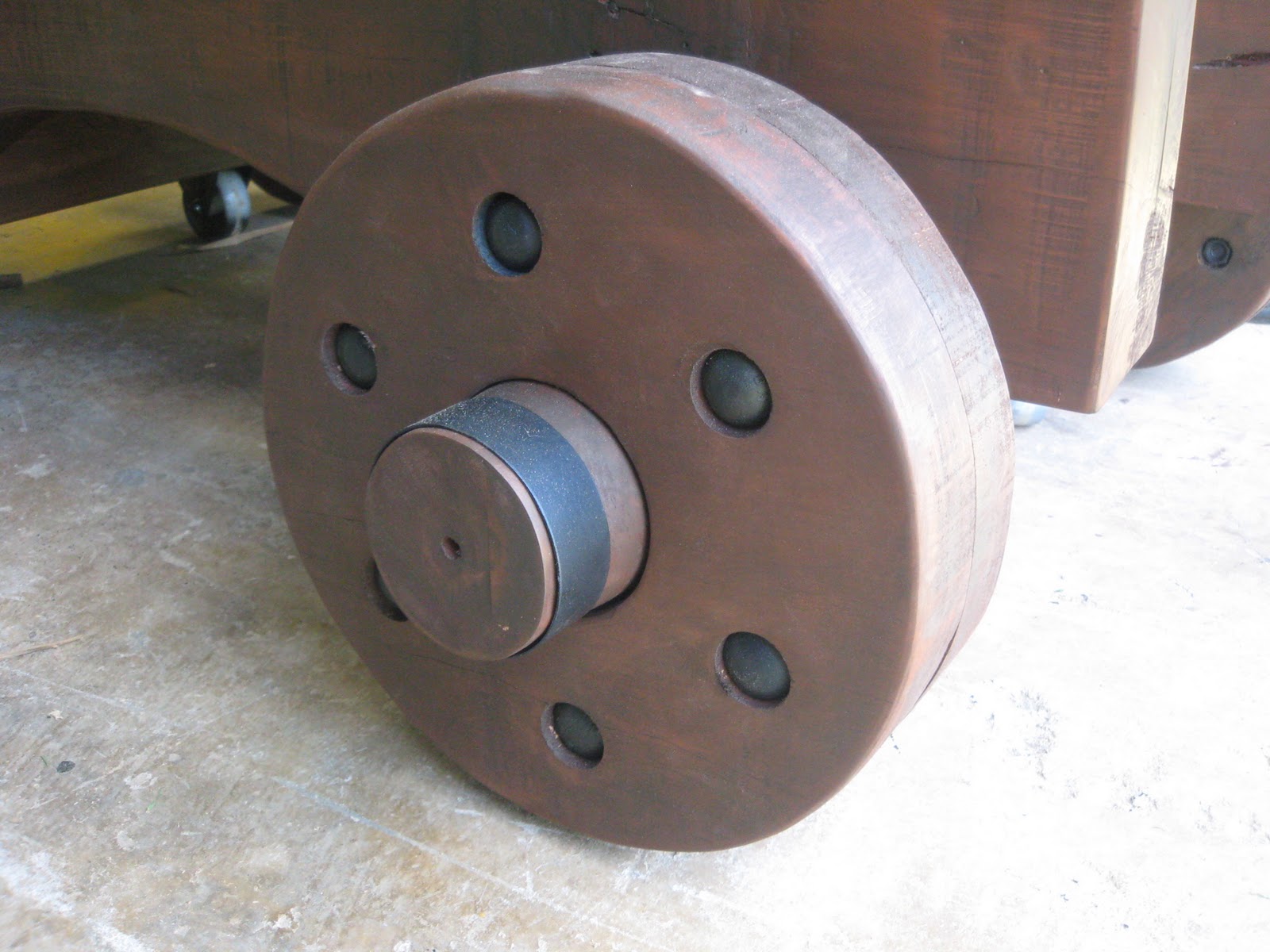
The cannon has come home to sit on a new gun carriage made for us by Peter Horrocks. It is worth a visit to the Pier Store just to see Peter’s carriage - it is beautifully hand made to the exact original carriage plans and is a major addition to our displays and in particular, the display of the cannon. As large pieces of Norfolk Island Pine were needed for the construction, timber was specially sourced by John Pearson and Charles Christian-Bailey. The steel work for the cap squares was made by Greg Horrocks and KCI once again made a supporting frame for the cannon to actually sit on. Our sincere thanks to Pete, John, Charles, Greg and KCI.

Once again, the Museum has benefited from local skill and ingenuity and a major item of great significance to this community as well as internationally has been successfully handled and cared for.  We invite you to visit the Pitcairn Norfolk Gallery in the Pier Store to see our newly conserved Bounty cannon sitting on its hand-made carriage. This project was funded by the National Library of Australia through their Community Heritage Grants Program.

Up-town Museum Presence
We were recently asked by Baunti Escapes to provide a major display of our Museum tickets, products and tours in their Burnt Pine office. We have long desired the opportunity to have a substantial up-town display to ensure that visitors learn about the existence of our museums in the early stages of their holiday. One of the most common things we hear is “if only I’d found out about the museums earlier in my stay” – as visitors realise that more than the last morning or afternoon of their holiday is needed to really explore all we have on offer.

Many thanks to Baunti Escapes for providing this valuable space to us. Next time you walk past their office drop in to see the new home for our replica Bounty cannon made as part of the Bounty cannon conservation project, and displays on our museums and tours – including the chance to dress up and have your photo taken in either a Bounty or judges outfit (from the Trial of the Fifteen). Bring your camera for lots of fun!

Can you help us?
We recently received an enquiry asking for information about Carnfield (Carn or Karl) Bancroft. Carn managed the whaling station here in the early 1960s and lived in the Royal Engineers Office (now the R.E.O. Café and Bookshop) in Kingston with his wife Sybil. One of his descendants is looking for information about his time here on Norfolk. We would really appreciate your call on 23788 if you have any information we could pass on.

Thursday, November 18, 2010

Maritime Archaeology Training


Last weekend 25 locals with a common interest in our maritime heritage spent their time in the Museum Theatre at Kingston attending a course on Maritime Archaeology. Everyone successfully passed Part 1 of the course offered by the Australasian Institute of Maritime Archaeology (AIMA) and Nautical Archaeology Society (NAS). Cass Phillipou and Sarah Ward were our main tutors and Andy Viduka also taught some sessions. Cass, Sarah and Andy are all members of AIMA and were here with funding provided to the Museum by the Commonwealth’s Historic Shipwrecks Program (Andy is the Assistant Director of Maritime Heritage in that Department).

 We were incredibly lucky to have these three run our course – not only are they very experienced maritime archaeologists and professionals, but their passion and enthusiasm for the subject made our learning experience a really enjoyable one, and as easy as possible. We covered topics that were totally new to most of us and there was a lot to take in including the Legislations covering shipwreck material, Archaeological Principles, site survey methods and conservation. We even managed in our small groups to survey parts of the New Gaol! The course is designed as an effective way to learn basic underwater archaeological skills.

AIMA is the only non-government organisation involved in maritime archaeology at a national level. It was formed in 1982 to assist in developing the maritime archaeology profession and furthering the aims of programs and projects carried out in Australia and other parts of the world. Volunteers make up a large part of maritime archaeology expeditions around the world and Membership of AIMA and Certification through the courses they offer, can provide the opportunity to volunteer on expeditions around the world.

After passing a short exam the outcome of our efforts was the presentation of Certificates certifying that we had each passed Part 1 of the AIMA/NAS course, and Membership to AIMA. Another outcome was that the group came together again during this week to start a Maritime Archaeology Association on Norfolk Island. This is incredibly exciting as it marks the beginning of a volunteer group of divers and non-divers who will research, locate, document and protect our maritime heritage. There will be further information provided by the group in coming weeks as they begin to confirm their purpose and objectives and formally establish themselves as an Incorporated Association.  This is great news for Norfolk – and for future generations of Norfolk Islanders.

Thursday, October 28, 2010

Bounty Cannon Project near Completion


We are inching closer to the end of our Bounty Cannon Conservation Project, funded through a Community Heritage Grant from the National Library.

This has been a fabulous project to undertake on so many levels – most importantly our cannon is now rust free, and with new sealants to preserve it for years to come. Janelle Blucher has overseen all this work, painstakingly moving back and forth over the surface of the cannon to ensure the job has been done perfectly. We established a wonderful new relationship with Phillip Smith and the Museum of Tropical Queensland when he came to make the cast for us. We have also been able to engage with the skill of locals, in particular Lee Irvine and Peter Horrocks and volunteer Sue Brian. Lee was invaluable in working with Phillip during the making of the cast and also brought the know-how to move around and work with a half tonne object. Peter has made a truly beautiful carriage for the cannon to finally rest on which is quite a work of art in its own right. And Sue has given countless hours supporting Janelle with all the steps of the conservation process. While we won’t congratulate ourselves until the cannon is safely back on display in the Pitcairn Norfolk Gallery in the Pier Store, I’m sure this will be a project we look back on with great satisfaction and pride.

Testing the carriage with the replica cannon
Rhonda Griffiths sent me a link to the September edition of ‘Dem Tull Pitcairn News’ recently. Tim Young has written a great article on Pitcairn’s Bounty Cannon at www.demtullpitcairn.com. Tim says:

The Bounty’s cannon did not see too much action, and seem to have been only used in anger during the aborted attempt by the mutineers to settle on Tubuai. Even then the only confirmed kill was a house rafter, as described by Bounty’s Boatswains Mate James Morrison: “(the mutineers) fired a four-pounder shotted among them (potentially hostile Tubuaians), at which they fled. The shot did no other damage then passing through a house where it cut away a rafter to which a man was hanging a gourd of water, and at which he was so terrified that he left the house.” 

The final seal is applied
When the Bounty was turned into a floating bonfire, all four cannons were still aboard.. Anyway, over fifty years later, in January 1845, two were recovered, and one was made into working order again. Sadly, this working cannon misfired on Wednesday 26th January 1853 as they were trying to salute the H.M.S. Virago, injuring three. One of these was the Island Magistrate Matthew McCoy, and he died of his injuries about 12 hours after the accident. As a result, the cannon was spiked, and many years later it was given to a passing ship (I tend to call this one the “killer cannon”). The other cannon was taken to Norfolk Island where it is on display to this day. The two remaining in the ocean stayed as such until June/July 1973 when the third was recovered, and today sits outside a private home in Adamstown. The final one remained untouched until it was raised in 1999 and sent to the Museum of Tropical Queensland for preservation. It was returned last year. Having sat in a box since its return last year, a replica carriage was built, and after putting the cannon on it, and a Perspex case around it, it now sits in the Pitcairn Island Museum for all to see”.

Wheel detail

Making the supporting sections
 

Tuesday, October 26, 2010

Whale Watching on Norfolk Island

In years gone by Norfolk Island had an active whaling industry where whales were hunted and killed for their oil. However when we talk about whaling on Norfolk Island today, we are talking about the conservation of whales and the wonderul activity of whale watching. Two dedicated whale conservationists have been visiting the island every year for the past 8 years, spending a month here each time tracking the movement and numbers of whales that pass by the island. Adrian Oosterman and Merv Whicker have given countless hours of their time to the whales and Norfolk Island.

This year their visit has been a bit of a disappointment as the weather has not allowed many boat trips to occur and the wind has made the spotting of whales very difficult amongst choppy seas. On these trips they capture photos to ID the whales, take skin samples and hydrophone recordings. However they had a fantastic day spotting a dwarf minke whale the other day. Adrian said "Finally got on the water on Tuesday and came across this minke (dwarf) whale. Actually, we were attempting to locate a mother/calf pair of humpbacks when we came across the minke. One of the most outstanding experiences I have had with whales. This whale mugged the boat for about 45 minutes and could have jumped aboard. Came that close we could have patted it on the nose, but didn't of course. Finally broke away and headed towards the humpbacks, but they were not interested and they managed to give us the slip".

They were on-board Howard Christian's boat at the time and managed to get these wonderful images.The top photo is of a humback and the others are the minke.