Showing posts with label cannon. Show all posts

Wednesday, August 25, 2010

Progress of Conservation of the Bounty Cannon


Final removal of Kwik Strip from the touch hole

Over the last few weeks we’ve been following the story of our Bounty Cannon Conservation Project, funded by the National Library of Australia through the Community Heritage Grants Program. The first step was the making of the replica cannon and now that that is complete we have begun the conservation work. Janelle Blucher has been heading this work with phone advice from Karina Acton from International Conservation Services.

Janelle has been assisted by our wonderful volunteer Sue Brian who has been there each day to help with the work. The first step they had to undertake was the removal of the surface coatings. Until they began applying the Kwik Strip, which is then brushed and washed off, it was not clear how much time this would take but we had set aside a week to do the job. However progress was so good that they had removed all the coatings by Wednesday afternoon. And when the coating was removed we discovered that the surface corrosion activity was not as bad as we had thought it could be. The top side of the cannon has more corrosion than the bottom side, which you would expect as it is more exposed. The heavier areas of corrosion are being treated with citric acid thiourea poultices, before a rust converter is applied and finally the whole cannon will be sealed with Senson Ferroguard to protect it against future corrosion.

The bore of the gun was trickier to assess. We knew that this was the area with the most corrosion and was going to be the most difficult to work with. As the bore goes right up to the touch-hole region which is 1.5 metres long, it presents us firstly with the difficultly of being able to see all the way up, and secondly with how to get to the top area to clear the corrosion. Using a long arm torch Janelle and Sue were able to see up to the top area and asses the corrosion. Once again we were very pleased to discover that it appears the corrosion does not go deep into the cannon.
Tlting the cannon to get to corrosion in the bore

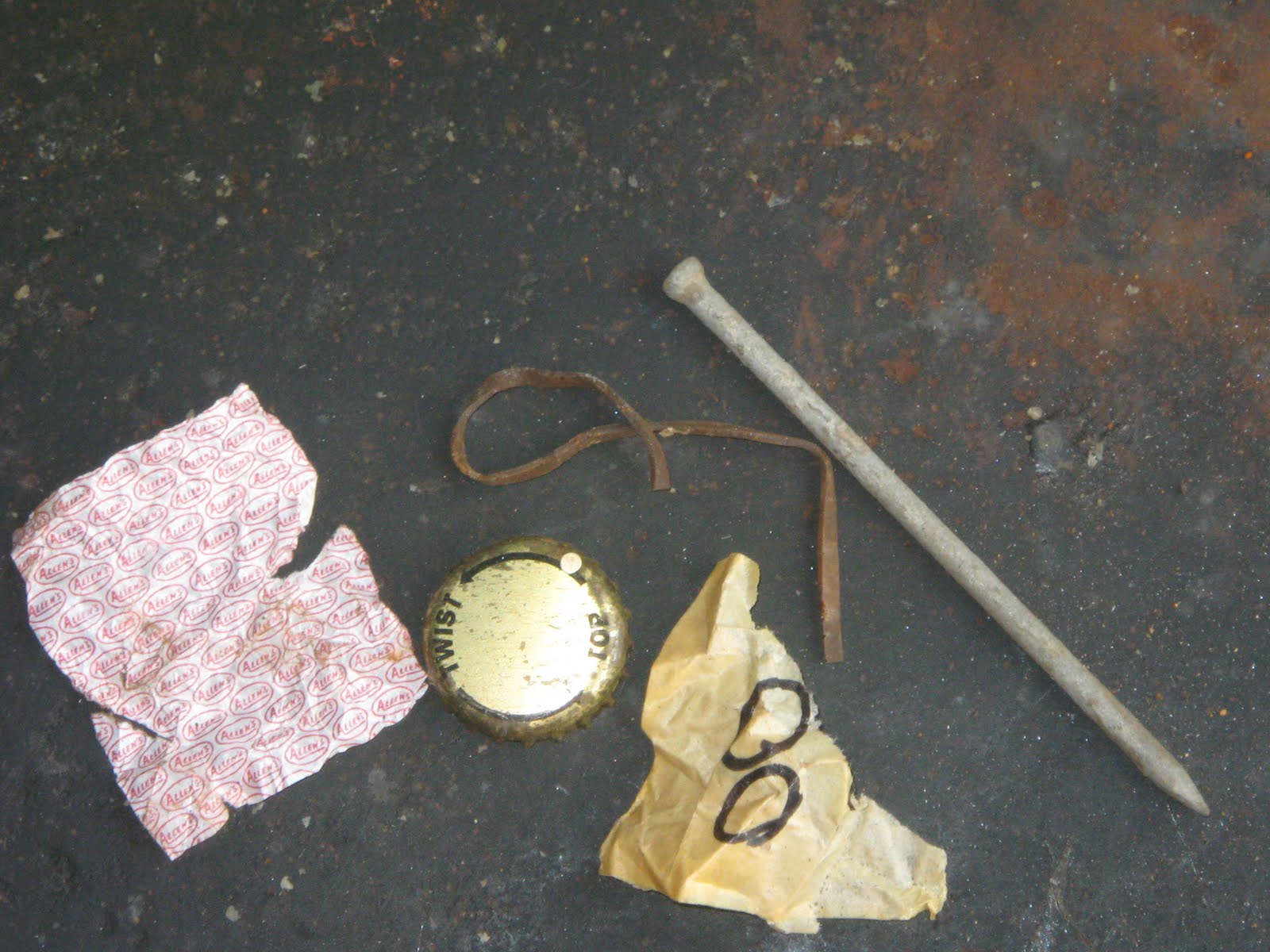
With the help of Lee Irvine the cannon was tilted so that the iron corrosion could be removed with a wire brush mounted onto a 2 metre extension arm and also an air gun on an extension. A few objects that we weren’t expecting to see came out of the bore during the brushing – a beer top, an Anticol wrapper, a piece of paper and a nail - not quite from 1790! A series of sprayings with rust converter and dewatering then occurred.

Finally,  Senson Vapour Guard Pads will be inserted, which are corrosion inhibitors, together with silica gel and then a tampion will be inserted into the end to seal the bore. All these treatments have been recommended by the Western Australian Maritime Museum and Karina Acton.
Wire brushing
Kel Adams came into the Museum with an article from Pix Magazine, August 19, 1950 (reproduced here). It has a photo of the cannon in the New Military Barracks compound being inspected by Johnnie Young, Pastor Pat Adams, Ben Christain and Carty Christian. A fabulous image and amazing to see the cannon where it stood for so many years before being restored in Western Australia – many thanks Kel for bringing it in. If anyone has any other images of the cannon, particularly when it was used in the Compound on Bounty Days, I would really appreciate being able to see them. Please give me a call on 23788.
Using the air gun to remove debris
Unexpected finds from the bore of the cannon!


It has been fascinating to watch the progress of this Project. One of the most inspiring aspects has been that the solutions to all of problems posed with handling the cannon have been resolved by our local people. We should not underestimate the skill of our local Administration and Museum workers – it is solid indeed.
From PIX Magazine, 19 August 1950

Wednesday, August 11, 2010

How to turn over a half tonne cannon

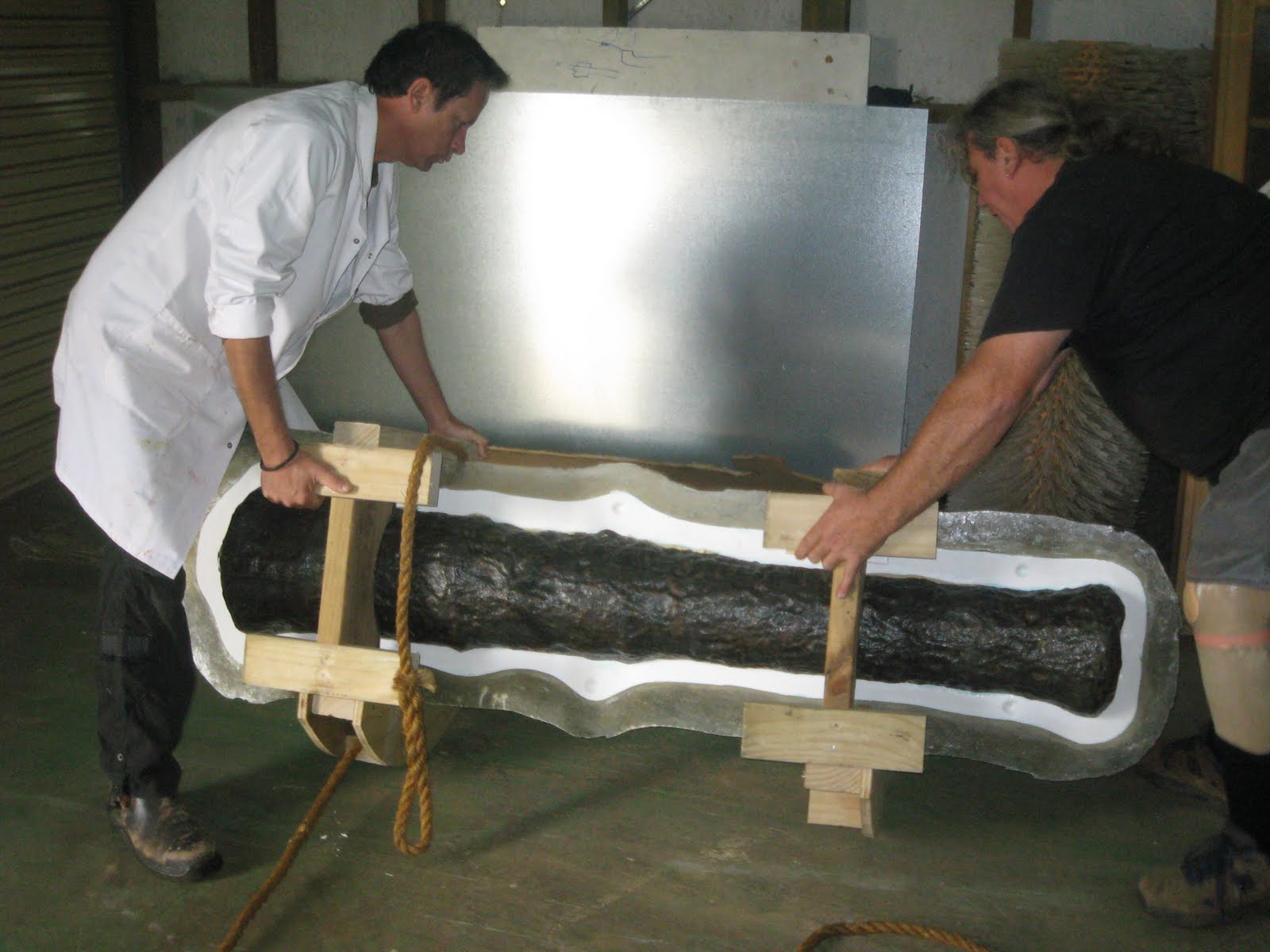
Our Bounty cannon has been transformed! One half of it has a layer of silicon topped with fibre glass and it has been turned over for the other side to now receive the same treatment. These are the steps in making a replica cast of the cannon.

With its silicon cover
Boxed up ready for turning
The work is being carried out by Phillip Smith from the Museum of Tropical Queensland as the first step in a conservation project on the cannon. The project has been funded by the National Libary through the Community Heritage Grants Program and after the replica has been made the cannon will have its coating removed, surface corrosion removed and may then be immersed into a tank of solution for a number of months.

Phillip is making a two part mould of our cannon from silicon and fibre glass. He started off work by making a timber cut out around the cannon which provided the barrier for making the two parts of the mould. A layer of silicon was then applied and then a layer of fibre glass. After all that had dried – the cannon was turned over for the other half to undergo the same process. Phillip is being assisted with his work by local Lee Irvine. As you can imagine plenty of thought needs to go into how to turn over a half tonne cannon. As you can see in the photos, Phillip and Lee managed the manouvere perfectly!

A public viewing of Phillip's work on the cannon will be held on Wednesday 18th August at 1.00pm at the Works Depot. Phillip will explain the moulding and casting procedure and also give an overview of the work he carries out for the Museum of Tropical Queensland. If you would like to attend this free event please register with the Museum on 23788.


Step one - lift the cannon
Step two - place it one the floor
Step three - roll it over


Step four - landed gently!

Wednesday, July 28, 2010

Bounty Cannon Conservation

If you happened to see a cannon travelling on the back of a truck through Burnt Pine the other day, don’t worry we are not readying ourselves for enemy invasion! The cannon is the Bounty cannon, and it was being taken to the Works Depot in readiness for conservation treatments about to begin in the next few weeks. It usually sits in the Pier Store Museum, one of the most important objects on display in our Pitcairn Norfolk Gallery.

Moving a half tonne cannon is not an easy proposition, particularly as it sits upstairs in the Pier Store. Once again we were able to call on the expertise (and muscle!) of the KAVHA Works team to move it for us. As you can see by our photos the first step involved six strong men lifting it onto a prepared crate, which was sitting on top of a forklift, just outside the small side door. The forklift was then lowered to ground level and the cannon was transferred onto the back of a truck and driven up to the Depot. Thanks to David Magri and the KAVHA team for their support in undertaking this delicate operation.

This cannon is one of four, four pounder cannons aboard the Bounty when she arrived at Pitcairn Island. It is a standard design Naval gun and was put onto the Bounty when she was refitted from May 1787, prior to sailing for Tenerife on 23rd December 1787. It would have been mounted on a wooden carriage. It is known from the diary of George Hunn Nobbs that this cannon and one other were raised in 1845. One was used to salute ships visiting Pitcairn until 1853 when an accidental firing killed the island’s Magistrate. There is no record as to wether this is the cannon that fired the fatal shot.

The cannon was brought to Norfolk in 1856 when the entire population of Pitcairn Island left to relocate to Norfolk Island. On Norfolk it stood for many years outside the Military Hospital in Kingston. In the mid 1970s it was included in conservation work carried out by the Western Australian Maritime Museum, and travelled to Perth for that treatment. After it was returned to Norfolk it was included in the newly established Maritime Museum when it opened in 1988.

One of our photos shows the cannon being unloaded from the back of a Hercules when it was returned from Western Australia in 1978. Many thanks to Di Adams for the photo – it shows her father Mack and his cousin Billie Pumpa unloading her.

The cannon is now in need of further conservation treatment. A 2006 report by Jon Carpenter and Richard Garcia from the Western Australian Museum says it “is showing signs of corrosion activity beneath its surface coating. The coating will have to be removed in order to re-treat the canon”. In addition, there is significant corrosion and delamination of the bore, which is uncoated. The conservation work has been funded by the National Library of Australia through the Community Heritage Grants scheme.