The Norfolk Island Agricultural and Horticultural Show
Yesterday was the 150th showing of the A&H Show. However did you know that it was Fletcher Christian’s first cousin John Christian Curwan, who is credited with founding the first Agricultural Show in England when he established the Workington Agricultural Society in 1805? His work in scientific agriculture earned him the title of “The Father of Agriculture”. Over 200 years later no doubt some of his cousin’s descendants will be vying for prizes at a show that may not be too dissimilar to that of his own!
During the Sesqui-centenary in 2006, one of the community exhibitions at the Museum was devoted to the A&H Show. Mary Christian-Bailey provided a fabulous overview of the history of the show – reprinted here to enjoy once again.
“The first Norfolk Island Show was held on 21st February 1860, and created great interest in the community, newly arrived from Pitcairn Island. An extract from a letter written by Andrew Christian on 14th September 1840 to Bishop George A. Selwyn reads:
“Everybody is busy. All are striving for the prize which is to be given to the person who raises the best 200 heads of corn and another for the one who gets most of the different sorts of things such as cabbages, yams, onions, bananas, sugar cane etc. and another is for the woman who makes the best three school dresses. All prizes to be one pound each”.
From their arrival in 1860 to their departure in the early 1920s, the Ministers of the Melanesian Mission of Norfolk Island actively participated in the organisation of the Society. On 8th December 1880 the day after St. Barnabas Chapel was consecrated, a Horticultural Show was held at Longridge, at which there was a Spring and Autumn Show, the later being held on the Thursday in Easter week. The Rev. John Palmer was then President of the Society. Judges in the agricultural section were Mr. Stephen Christian, Mr. David Buffett and Mr. Hardy Rossiter. In the horticultural section, Rev. John Palmer, Dr P.H. Metcalfe and Dr. Codrington were judges.
The Society’s Show on 10th November 1921 was well attended. There were five sections for farm produce with excellent exhibits of potatoes, kumeras, yams and various vegetables as well as many sections for arts and crafts. The classes attracted 430 exhibits from a population of approximately 699 persons. Fifty-three pounds five shillings and nine pence was paid out in expenses including prize monies.
The Administrator, Major-General Selheim, C.B.M C.M.G officially opened the Annual Show on 23rd November 1927. The Secretary at that time was Mr. Ernests V. Stephenson and the Show attracted 473 exhibits. Mr. Ivens Nobbs carried off the prize for the best bunch of bananas. It stood 4 feet high and the bananas measured some 7 inches long. Mrs. C.C.R. Nobbs won the silver cup presented by the Society for the exhibitor gaining the greatest number of points. The Show Schedule in November 1931 shows the Patron as Colonel A.J. Bennett, the President Mr. C.C.R. Nobbs, and the Secretary/Treasurer as Mr. A.A. Greenwood. Competition was invited in 150 classes and many more local crafts were included than at present. The livestock section was confined to two classes for pigs.
During the Centenary Celebrations in June 1956, the Society organised an exhibition in the Methodist Hall. The President was Mr G.G. F. Quintal with Mr. N.V.D. Kilvert as Secretary. The Exhibition was opened by the Governor-General of Australia, His Excellency Sir. William Slim, C.C.B., G.C.M.G., G.B.E., D.S.O., M.C. On 18th July 1968 her Majesty the Queen was graciously pleased to grant Her Patronage to the Society. The President during the year was Mr. J. Carr with Mrs. Tim Lloyd as Secretary.
1974 was the Bi-Centenary Year of Norfolk Island’s discovery by Captain James Cook, and the Society’s Show was held on 14th October during the week of the Bi-Centenary celebrations. The venue was the Rawson Hall Memorial Hall and adjacent grounds (named the Bi-Centenary Centre). The Society invited entries in 407 classes and attracted a total of 2204 entries. The Show was officially opened by Air Commodore E.T. Pickerd, O.B.E., D.F.C. and approximately 1658 people including children passed through the gates to visit the show. In 1978 His Honour the Administrator, Mr. D.V. O’Leary, V.R.D., in opening the Show announced that Her Majesty The Queen had granted her approval of the use by the Society of the prefix ‘Royal’. The President during the year was Mr. David E. Buffett.
By 1984 entries had reached an all-time high of 3,060. This was the year that we were honoured by a special visit of His Excellency the Governor-General, Sir Ninian Stephen, who accompanied by Lady Stephen, officially opened the Show. In 1985 the 125th Anniversary of the first Exhibition was high-lighted with the issue of two commemorative postage stamps, the miniature sheet being reproduced in full colour on the cover of the Show Schedule. Special prizes were awarded for classes recorded as being in the 860 Exhibition. 1985 also saw the innovation of a Woodchop Team from Queensland.
The Bi-Centennial Show in 1988 was officially opened by the Duke of Norfolk on 17th October. The Duke was accompanied by the Dutchess of Norfolk and this was the first visit by any member of the family. In 1992 the Society moved onto its own premises on the Bi-Centenary Show ground. The building was officially opened on the 21st April by His Honour the Administrator Mr. Alan Kerr”.

Welcome to the Norfolk Island Museum's blog. We are lucky to be located in the most beautiful part of a stunning island in the South Pacific. We are a little island, but our history and stories are great - from Polynesian and convict settlements to the home of the Bounty mutineers. Hopefully you'll enjoy our stories.
Monday, October 11, 2010

Thursday, September 30, 2010
More news from Pauline Reynolds-Barff
More news from Pauline Reynolds-Barff on her Churchill Scholarship Tour
THINKING ABOUT THE PACIFIC IN THE UK
For someone who has spent most of her life in the Pacific, it’s been a real revelation to me to travel to the UK via New Zealand and Hawai’i … I’ve been glad for the itinerary that led me gently out of the Pacific then onto Los Angeles airport and onwards to Heathrow.
My scholarship is to study the material culture left by our Polynesian foremothers who boarded the HMS Bounty in 1789 bound for Pitcairn – barkcloths gifted to passing captains which eventually made their way into European museums. Now I find myself making my way to them by joining the dots on a vast museum map working toward the north of the UK and then across to Norway. Since my last report I’ve been to museums in London, Cambridge and Oxford.
I’ve been surprised and disappointed at the minimal Pacific representation in British museum displays in general. So it is a sweet thing indeed to have seen two Pitcairn barkcloths on display in public galleries: one in the British Museum (in the Enlightenment Gallery: a tiny piece by Mauatua, Fletcher Christian’s sweetheart) and the other at the Pitt Rivers Museum in Oxford (a lovely patterned poncho). Another pleasant surprise is the resoundingly enthusiastic reception I have received at each of the museums I have visited by the hard-working curators of huge out-of-sight collections.
Behind archive doors there have been more, so many more, pieces of beautiful barkcloth for me to ponder over. Some white and finely made - others a patchwork of colours. A great side effect of my visits is the raising of awareness of the significance of these pieces. I am hoping that, even in a small way, my visit may change the way the pieces are viewed within the museums, because an item with a story makes it so much more valuable.
By the time you read this, I will have left Oxford and will be working my way up to Scotland where there are several interesting barkcloths.
PS … I wish to apologise to those who asked me to write a blog - I just haven’t had enough time but will make it up to you when I come home.
Pauline Reynolds Barff

THINKING ABOUT THE PACIFIC IN THE UK
For someone who has spent most of her life in the Pacific, it’s been a real revelation to me to travel to the UK via New Zealand and Hawai’i … I’ve been glad for the itinerary that led me gently out of the Pacific then onto Los Angeles airport and onwards to Heathrow.

 |
| Pitt River Tapa on display |
 |
| Mauatua tapa on display at the British Museum |
My scholarship is to study the material culture left by our Polynesian foremothers who boarded the HMS Bounty in 1789 bound for Pitcairn – barkcloths gifted to passing captains which eventually made their way into European museums. Now I find myself making my way to them by joining the dots on a vast museum map working toward the north of the UK and then across to Norway. Since my last report I’ve been to museums in London, Cambridge and Oxford.
I’ve been surprised and disappointed at the minimal Pacific representation in British museum displays in general. So it is a sweet thing indeed to have seen two Pitcairn barkcloths on display in public galleries: one in the British Museum (in the Enlightenment Gallery: a tiny piece by Mauatua, Fletcher Christian’s sweetheart) and the other at the Pitt Rivers Museum in Oxford (a lovely patterned poncho). Another pleasant surprise is the resoundingly enthusiastic reception I have received at each of the museums I have visited by the hard-working curators of huge out-of-sight collections.
Behind archive doors there have been more, so many more, pieces of beautiful barkcloth for me to ponder over. Some white and finely made - others a patchwork of colours. A great side effect of my visits is the raising of awareness of the significance of these pieces. I am hoping that, even in a small way, my visit may change the way the pieces are viewed within the museums, because an item with a story makes it so much more valuable.

By the time you read this, I will have left Oxford and will be working my way up to Scotland where there are several interesting barkcloths.
PS … I wish to apologise to those who asked me to write a blog - I just haven’t had enough time but will make it up to you when I come home.
Pauline Reynolds Barff
Tuesday, September 28, 2010
Conservation Report for the Bounty Cannon
This report details the work that has been done on the cannon to date. It is still undergoing treatment which is expected to continue for another few weeks. This is a fairly technical report as it has been written by our Conservation Office Janelle Blucher as part of our formal Condition Reporting regime. Despite its technical nature - it is still a really interesting report.
Conservation Report for The Bounty Cannon - September 28 2010
The initial objective was to remove a coating of Kephos primer, F & T Imperite 390 (polyurethane). This coating was applied to the surface of the cannon 32 years ago .
Description of Kephos Primer (sourced from supplier of product): Non – aqueous liquid chemical used undiluted (except for dip operations) to produce corrosion resisting, paint bonding coating on steel. The paint grip coating when dry protects the surface from fingerprints, rust, etc. – usually for 6 months
Karina Acton of International Conservation Services tried to remove the coating with various solvents whilst on the island in 2008, eventually the only effective removal came about with the use of Selley’s Kwikstrip. A sample of the coating was removed by Karina and taken back to I.C.S to further test for any other means of removal. It was determined that the best option was to use Selley’s Kwikstrip.
One of the lockable sheds at the Administration works depot was set aside for the conservation area, this provided protection from weather and also salt air. Lee Irvine from the Works Depot made a wooden cradle for the cannon to sit on whilst undergoing conservation. The cannon was situated under a block and tackle which enabled a method of rotation for conservation purposes as well as being able to elevate at the cascabel end.
Conservation method -Week 1
Patch test 1 – Kwikstrip applied and left on the cannon for 5 minutes, then washed off resulted in no visible removal of coatings.
Patch test 2 - Kwikstrip was left on the surface for 10 minutes, washed off resulting in some removal of coating, what appeared to be approx. 25%.
Patch test 3 – Kwikstrip was left of the surface for 15 minutes, washed off resulting in approx. 75% removal of coating.
This satisfied any concern that the application of Kwikstrip was going to have any adverse affect to the surface of the cast iron and with repeated coatings of Kwikstrip the coating would eventually be removed. Proceeded to apply Kwikstrip working in sections throughout the day until entire surface had been treated twice over. Left overnight to observe any changes to the cast iron being exposed. A third application of Kwikstrip was painted on the following day and this appeared to remove the remainder of the coating. Brushed repeatedly with a nylon brush (dish brush) and washed repeatedly, final washes were with water collected from dehumidifiers (distilled water is not available). The exposed surface of the cannon had less corrosion than we anticipated, however approx 50% of the surface area did have superficial corrosion areas. These spots were scraped with a scalpel and brushed with a soft wire (ferrous) brush.
Communication with Karina Acton: Emailed images of cannon to Karina and phoned to inform of the process and results at this stage. The cannon obviously showing less corrosion than expected resulted in the decision to not immerse the object in a bath of caustic solution with electrolytic reduction process. She suggested using Citric Acid 5%/Thiourea 1% poultices on patches of corrosion. These poultices were applied and left on for approx 15 minutes and then thoroughly washed off with water. Mechanical and chemical removal of these superficial corrosion areas on the outside surface of the gun continued throughout the week.
Treating the bore:
The cannon was elevated approximately 20 degrees at the cascabel end. A flat round wire brush was attached to the end of a steel rod which reached up to the end of the bore (approx. 2metres) this was used initially to scrape out the delaminated iron. The wire brush and rod was attached to an electric drill and the inside heavily brushed to remove the flaking and delaminating material, a total amount of 263gms was removed. Compressed air was blown through a hose attached to a rod which reached up to the end of the bore to remove all dust.
Thin metal tubing with holes punctured around the end was attached to a spray gun, this tube also reached to the end of the bore. A substantial spray of methylated spirits was applied and allowed to dry. The bore is clean and has a smooth surface except for one chunk of delaminating iron which would not come away, this piece is near the muzzle end of the gun and can be easily monitored and removed at a later time if necessary. The same spray gun was then used to apply a substantial amount of Senson Rusticide (corrosion converter), this process was repeated twice and after examination with a light we could see a thorough application was achieved. The bore did not have the coating of Kephos Primer and F & T Imperite 390 like the outside of the gun.
There was an unidentified coating around the circumference of the bore, approximately 2cm in from the muzzle and approx. 10cm in length. It appeared to be wax, no solvent would remove it and Kwikstrip wasn’t having any affect. Heat was applied to a patch with a hot air gun and this turned it white and sticky similar to chewing gum consistency. It appeared to be silicon, this was eventually removed mechanically with scalpel and wire brush and the area received its 2xcoatings of Senson Rusticide. A coating of Senson Rusticide was painted on the whole outside surface of the gun on the Friday afternoon and it was left for 2 days.
Week 2
Continued working on areas of corrosion on outside surface of cannon using scalpel, soft wire brush and methylated spirits which removed most of the Rusticide that had been applied. It soon became very evident that microscopic pieces of the original coating still remained. The surface of the gun is quite uneven and pitted and these small pieces of coating were embedded into the ‘pores’ of the cast iron.
Communication with Karina Acton: Emailed images of cannon and informed Karina of these remaining small pieces of coating and she advised to return to further use of Kwikstrip until all had been removed. Corrosion treatment would not reach the metal that was underneath these remaining pieces of coating.
Washed with water collected from dehumidifiers and brushed (nylon brush), dewatered (methylated spirits) and returned to Kwikstip application and removal. Hot water was tried in some areas to maneuver the Kwikstrip into and out of the pores. A scalpel was used to remove any stubborn coating that had been softened but not removed by Kwikstrip. Repeated Kwikstrip process numerous times and washed, dewatered and brushed with nylon brush numerous times. Superficial corrosion areas treated with the citric/thio poutices, localised ‘shaving’ with a scalpel, and soft wire brushing. Friday afternoon completed with an application (brushed) of Rusticide to the entire outside surface of the cannon.
Week 3: Removed Rusticide with dehum. water, dewatered (meths.) and brushed with nylon brush, applied Kwikstrip process to any further areas of remaining coating. Brushing cannon with nylon brush after dewatering seemed effective in removing any microscopic flakes of loosened coating. The cannon was continuously examined under artificial lights and sunlight when possible and a magnifying glass, finally satisfied that all of the original coating had been removed. Fine ‘shaving’ of superficial corrosion areas still revealed a layer of fine ‘brown’ powdery corrosion.
Communication with Karina Acton: Karina was satisfied with amount of time spent working on the removal of the surface coating, her original observations of this coating had led her to believe that it would take approximately 2 weeks of continuous ‘work’ to remove it. It was acceptable if 95% of the coating had been removed, a percentage that was certainly achieved. A fine layer of brown powdery corrosion products is acceptable and expected on the object. Further treatment with citric acid/thiourea solution was recommended. Senson Rusticide to be applied and object left for a few weeks for observation purposes prior to final sealing of the surface with Senson Ferroguard.
A fresh solution of 5% Citric Acid/ 1% Thiourea was prepared and brushed over the surface in sections until entire surface was treated. This solution was applied 3 times and left on for 15 minutes each time (Approx. total of 450ml). Repeated washing with dehumidifier water, brushing and dewatering and brushing again with nylon brush between each application. Senson Rusticide was brushed onto the surface of the cannon, a second coating was applied the following day. A blow up ball wrapped in my mylar was pushed into the muzzle of the gun to provide a seal for the bore. Once Rusticide had dried the cannon was covered loosely with mylar topped by a cotton cover to keep off any dust.
Touch Hole: J. Carpenter 1987 WAMM report states that in 1977 “touch hole still to be drilled out (at present 2 inches deep).” No known documentation states that it was ever drilled out. Measurement now is a depth of 45mm which indicates this was never done. The touch hole was brushed with a thin nylon brush, washed, dewatered, paper was used a wick to draw out moisture and Rusticide filled the hole.
Core Sample Hole: This core sample was taken in the late 1970’s. A small hole measuring 16mm remains at the side of the gun at the cascabel end. Unable to fit nylon brush (width allows only a piece of tie wire to be inserted) otherwise received same treatment as the touch hole.
Conservation Report for The Bounty Cannon - September 28 2010
The initial objective was to remove a coating of Kephos primer, F & T Imperite 390 (polyurethane). This coating was applied to the surface of the cannon 32 years ago .
Description of Kephos Primer (sourced from supplier of product): Non – aqueous liquid chemical used undiluted (except for dip operations) to produce corrosion resisting, paint bonding coating on steel. The paint grip coating when dry protects the surface from fingerprints, rust, etc. – usually for 6 months
Karina Acton of International Conservation Services tried to remove the coating with various solvents whilst on the island in 2008, eventually the only effective removal came about with the use of Selley’s Kwikstrip. A sample of the coating was removed by Karina and taken back to I.C.S to further test for any other means of removal. It was determined that the best option was to use Selley’s Kwikstrip.
One of the lockable sheds at the Administration works depot was set aside for the conservation area, this provided protection from weather and also salt air. Lee Irvine from the Works Depot made a wooden cradle for the cannon to sit on whilst undergoing conservation. The cannon was situated under a block and tackle which enabled a method of rotation for conservation purposes as well as being able to elevate at the cascabel end.
Conservation method -Week 1
Patch test 1 – Kwikstrip applied and left on the cannon for 5 minutes, then washed off resulted in no visible removal of coatings.
Patch test 2 - Kwikstrip was left on the surface for 10 minutes, washed off resulting in some removal of coating, what appeared to be approx. 25%.
Patch test 3 – Kwikstrip was left of the surface for 15 minutes, washed off resulting in approx. 75% removal of coating.
This satisfied any concern that the application of Kwikstrip was going to have any adverse affect to the surface of the cast iron and with repeated coatings of Kwikstrip the coating would eventually be removed. Proceeded to apply Kwikstrip working in sections throughout the day until entire surface had been treated twice over. Left overnight to observe any changes to the cast iron being exposed. A third application of Kwikstrip was painted on the following day and this appeared to remove the remainder of the coating. Brushed repeatedly with a nylon brush (dish brush) and washed repeatedly, final washes were with water collected from dehumidifiers (distilled water is not available). The exposed surface of the cannon had less corrosion than we anticipated, however approx 50% of the surface area did have superficial corrosion areas. These spots were scraped with a scalpel and brushed with a soft wire (ferrous) brush.
Communication with Karina Acton: Emailed images of cannon to Karina and phoned to inform of the process and results at this stage. The cannon obviously showing less corrosion than expected resulted in the decision to not immerse the object in a bath of caustic solution with electrolytic reduction process. She suggested using Citric Acid 5%/Thiourea 1% poultices on patches of corrosion. These poultices were applied and left on for approx 15 minutes and then thoroughly washed off with water. Mechanical and chemical removal of these superficial corrosion areas on the outside surface of the gun continued throughout the week.
Treating the bore:
The cannon was elevated approximately 20 degrees at the cascabel end. A flat round wire brush was attached to the end of a steel rod which reached up to the end of the bore (approx. 2metres) this was used initially to scrape out the delaminated iron. The wire brush and rod was attached to an electric drill and the inside heavily brushed to remove the flaking and delaminating material, a total amount of 263gms was removed. Compressed air was blown through a hose attached to a rod which reached up to the end of the bore to remove all dust.
Thin metal tubing with holes punctured around the end was attached to a spray gun, this tube also reached to the end of the bore. A substantial spray of methylated spirits was applied and allowed to dry. The bore is clean and has a smooth surface except for one chunk of delaminating iron which would not come away, this piece is near the muzzle end of the gun and can be easily monitored and removed at a later time if necessary. The same spray gun was then used to apply a substantial amount of Senson Rusticide (corrosion converter), this process was repeated twice and after examination with a light we could see a thorough application was achieved. The bore did not have the coating of Kephos Primer and F & T Imperite 390 like the outside of the gun.
There was an unidentified coating around the circumference of the bore, approximately 2cm in from the muzzle and approx. 10cm in length. It appeared to be wax, no solvent would remove it and Kwikstrip wasn’t having any affect. Heat was applied to a patch with a hot air gun and this turned it white and sticky similar to chewing gum consistency. It appeared to be silicon, this was eventually removed mechanically with scalpel and wire brush and the area received its 2xcoatings of Senson Rusticide. A coating of Senson Rusticide was painted on the whole outside surface of the gun on the Friday afternoon and it was left for 2 days.
Week 2
Continued working on areas of corrosion on outside surface of cannon using scalpel, soft wire brush and methylated spirits which removed most of the Rusticide that had been applied. It soon became very evident that microscopic pieces of the original coating still remained. The surface of the gun is quite uneven and pitted and these small pieces of coating were embedded into the ‘pores’ of the cast iron.
Communication with Karina Acton: Emailed images of cannon and informed Karina of these remaining small pieces of coating and she advised to return to further use of Kwikstrip until all had been removed. Corrosion treatment would not reach the metal that was underneath these remaining pieces of coating.
Washed with water collected from dehumidifiers and brushed (nylon brush), dewatered (methylated spirits) and returned to Kwikstip application and removal. Hot water was tried in some areas to maneuver the Kwikstrip into and out of the pores. A scalpel was used to remove any stubborn coating that had been softened but not removed by Kwikstrip. Repeated Kwikstrip process numerous times and washed, dewatered and brushed with nylon brush numerous times. Superficial corrosion areas treated with the citric/thio poutices, localised ‘shaving’ with a scalpel, and soft wire brushing. Friday afternoon completed with an application (brushed) of Rusticide to the entire outside surface of the cannon.
Week 3: Removed Rusticide with dehum. water, dewatered (meths.) and brushed with nylon brush, applied Kwikstrip process to any further areas of remaining coating. Brushing cannon with nylon brush after dewatering seemed effective in removing any microscopic flakes of loosened coating. The cannon was continuously examined under artificial lights and sunlight when possible and a magnifying glass, finally satisfied that all of the original coating had been removed. Fine ‘shaving’ of superficial corrosion areas still revealed a layer of fine ‘brown’ powdery corrosion.
Communication with Karina Acton: Karina was satisfied with amount of time spent working on the removal of the surface coating, her original observations of this coating had led her to believe that it would take approximately 2 weeks of continuous ‘work’ to remove it. It was acceptable if 95% of the coating had been removed, a percentage that was certainly achieved. A fine layer of brown powdery corrosion products is acceptable and expected on the object. Further treatment with citric acid/thiourea solution was recommended. Senson Rusticide to be applied and object left for a few weeks for observation purposes prior to final sealing of the surface with Senson Ferroguard.
A fresh solution of 5% Citric Acid/ 1% Thiourea was prepared and brushed over the surface in sections until entire surface was treated. This solution was applied 3 times and left on for 15 minutes each time (Approx. total of 450ml). Repeated washing with dehumidifier water, brushing and dewatering and brushing again with nylon brush between each application. Senson Rusticide was brushed onto the surface of the cannon, a second coating was applied the following day. A blow up ball wrapped in my mylar was pushed into the muzzle of the gun to provide a seal for the bore. Once Rusticide had dried the cannon was covered loosely with mylar topped by a cotton cover to keep off any dust.
Touch Hole: J. Carpenter 1987 WAMM report states that in 1977 “touch hole still to be drilled out (at present 2 inches deep).” No known documentation states that it was ever drilled out. Measurement now is a depth of 45mm which indicates this was never done. The touch hole was brushed with a thin nylon brush, washed, dewatered, paper was used a wick to draw out moisture and Rusticide filled the hole.
Core Sample Hole: This core sample was taken in the late 1970’s. A small hole measuring 16mm remains at the side of the gun at the cascabel end. Unable to fit nylon brush (width allows only a piece of tie wire to be inserted) otherwise received same treatment as the touch hole.
Sunday, September 19, 2010
News from Pauline Reynolds-Barff
We’ve had a lovely email from Pauline Reynolds-Barff who left Norfolk a few weeks ago on her Churchill Scholarship trip. Pauline is visiting over twelve museums and collections around the world that hold pieces of tapa and other material relating to the Polynesian women who became the wives of the Bounty mutineers and are the foremothers of many Pitcairn and Norfolk Islanders. Pauline is the author of “Pitcairn Tapa: ‘Ahu no Hitiaurevareva”, (Ahu is Polynesian for tapa, and Hitiaurevareva is Polynesian for Pitcairn) which looks at some of the surviving bark cloths made on Pitcairn by the Polynesian women. She will be viewing some of these at the museums she visits as well as new pieces held in Hawaii, the UK and Norway. At the same time Pauline will be collecting other pieces of information on the women and their lives on Pitcairn. Through this she hopes to learn more about the vital role those women played in establishing the new community on Pitcairn. It is fascinating research that she is undertaking. Here is Pauline’s first report back to us…

Around The World In 6 Weeks – the fist 2 weeks …
Well how often have I silently given thanks to Mr Churchill for this marvellous opportunity to travel the world and search out material culture relating to our Bounty heritage.
I touched down in Auckland, then Wellington in early September … what a great town it is! Accompanied by Jean Clarkson and Sue Pearson, we declared ourselves on ‘Mother’s Annual Leave’ and enjoyed visiting the Turnbull Library and Te Papa Museum. Together we were greeted by curators and shown museum archives of tapa and beaters.
A few days later I flew out to Honolulu and stayed at my friend Lovina LePendu’s house … many of you may remember her coming to Norfolk to teach Tahitian tamure some years ago. She owns land near ours on Huahine. Honolulu of course was just coming out of summer so it was hot like Huahine … sigh! Off to the museum I went on my own this time. The Bishop Museum archives are old and a stark contrast to the new and lavish Wellington archive space. But what a great museum the Bishop is. So rich in history, and interesting to those of us who are drawn to all things Polynesian. I met up with a friend who is an expert barkcloth maker and we compared notes (actually I was the one mostly note taking!). We have a plan to meet as a group in Huahine in a couple of years to further our knowledge.
Then came the time for me to leave familiar places and faces and for the first time in my life leave the Pacific. After two long days of travel, I landed here in London. I didn’t expect to enjoy it as much as I am … though I have to say thank goodness for Skype, email and mobile phones. I’ve been lucky enough to be able to talk with my family every day since arriving and that has helped a lot with the homesickness I was dealing with earlier on in Hawai’i.
I’m blown away by London’s art, sculpture, museums and ease of getting around. By sheer luck I ended up in Camden Markets on my first day – what a trip! I have of course made ‘official’ visits to the British Museum – the days go so fast I know I wont end up doing a heap of sightseeing … but even just a little is marvellous. Things are different yet strangely familiar here – all those Monopoly games and history lessons must have sunk in. I have an idea ... our Norfolk Island kids come to England and go to Tahiti for a complete history round up - probably next to impossible but wow, wouldn't that be educational.
I’ve taken zillions of photos of course and notes on every scrap of paper I have … by the time you read this I will have headed off again to visit more museums around the UK… I’ll catch up with you next week … thank you to all those who have been so supportive – there’s no place like home.

Around The World In 6 Weeks – the fist 2 weeks …
Well how often have I silently given thanks to Mr Churchill for this marvellous opportunity to travel the world and search out material culture relating to our Bounty heritage.
I touched down in Auckland, then Wellington in early September … what a great town it is! Accompanied by Jean Clarkson and Sue Pearson, we declared ourselves on ‘Mother’s Annual Leave’ and enjoyed visiting the Turnbull Library and Te Papa Museum. Together we were greeted by curators and shown museum archives of tapa and beaters.
A few days later I flew out to Honolulu and stayed at my friend Lovina LePendu’s house … many of you may remember her coming to Norfolk to teach Tahitian tamure some years ago. She owns land near ours on Huahine. Honolulu of course was just coming out of summer so it was hot like Huahine … sigh! Off to the museum I went on my own this time. The Bishop Museum archives are old and a stark contrast to the new and lavish Wellington archive space. But what a great museum the Bishop is. So rich in history, and interesting to those of us who are drawn to all things Polynesian. I met up with a friend who is an expert barkcloth maker and we compared notes (actually I was the one mostly note taking!). We have a plan to meet as a group in Huahine in a couple of years to further our knowledge.
Then came the time for me to leave familiar places and faces and for the first time in my life leave the Pacific. After two long days of travel, I landed here in London. I didn’t expect to enjoy it as much as I am … though I have to say thank goodness for Skype, email and mobile phones. I’ve been lucky enough to be able to talk with my family every day since arriving and that has helped a lot with the homesickness I was dealing with earlier on in Hawai’i.
I’m blown away by London’s art, sculpture, museums and ease of getting around. By sheer luck I ended up in Camden Markets on my first day – what a trip! I have of course made ‘official’ visits to the British Museum – the days go so fast I know I wont end up doing a heap of sightseeing … but even just a little is marvellous. Things are different yet strangely familiar here – all those Monopoly games and history lessons must have sunk in. I have an idea ... our Norfolk Island kids come to England and go to Tahiti for a complete history round up - probably next to impossible but wow, wouldn't that be educational.
I’ve taken zillions of photos of course and notes on every scrap of paper I have … by the time you read this I will have headed off again to visit more museums around the UK… I’ll catch up with you next week … thank you to all those who have been so supportive – there’s no place like home.
Wednesday, September 8, 2010
Maritime Archaeology on Norfolk Island
Most of the focus of historic shipwrecks on Norfolk Island has been on the HMS Sirius. As the flagship of the First Fleet the wreck site and artefacts have national significance and so of course have been the focus of much attention. However there have been many other shipwrecks around Norfolk and there are various anchors and other objects that have been sighted by divers across the years. It is now timely to begin to shift our focus to trying to discover the stories of these other shipwrecks and objects and by doing so ensure that they are protected. We are very excited to be able to do this via some wonderful training in maritime archaeology that will be of interest to divers and non-divers alike.
On the weekend of November 6th and 7th the Museum will be running part 1 of the Australasian Institute for Maritime Archaeology and Nautical Archaeology Society (AIMA/NAS) course which will be run by Cass Phillipou, the senior AIMA/NAS tutor. This exciting course is able to be offered via funding from the Historic Shipwrecks Program. The aim is to start a Norfolk Island Maritime Archaeology Association which will help to plot shipwreck sites and objects, look for items and help protect those that are found.

The course is designed as a general introduction to maritime archaeology and will cover a wide range of issues and skills such as recording techniques and surveying methods. It will focus on the importance of shipwrecks to archaeology and our national heritage in addition to the basics of how to locate, identify and survey shipwrecks in a non-intrusive way. Other topics are definitions, archaeological sciences, material conservation, ship construction and State and Commonwealth legislation.
Normally this 8 hour course is $200.00 per participant, however as we are able to offer it with funding from the Historic Shipwrecks Program – it will be free to Norfolk Island participants. On completion, you’ll gain a 12 month membership to AIMA and an internationally recognised AIMA/NAS certificate.
This course will be of interest to people who want to enhance their diving experience, be involved in underwater projects and be part of a forum of wreck enthusiasts. You
don’t need to be a diver to be involved – there is plenty for the non-diver who is interested in our underwater archaeology. While we don’t want to knock back anyone, the class size limit will be about 20. If you’d like to hear more about the course or register your name for attendance please call me on 23788.
On the weekend of November 6th and 7th the Museum will be running part 1 of the Australasian Institute for Maritime Archaeology and Nautical Archaeology Society (AIMA/NAS) course which will be run by Cass Phillipou, the senior AIMA/NAS tutor. This exciting course is able to be offered via funding from the Historic Shipwrecks Program. The aim is to start a Norfolk Island Maritime Archaeology Association which will help to plot shipwreck sites and objects, look for items and help protect those that are found.

The course is designed as a general introduction to maritime archaeology and will cover a wide range of issues and skills such as recording techniques and surveying methods. It will focus on the importance of shipwrecks to archaeology and our national heritage in addition to the basics of how to locate, identify and survey shipwrecks in a non-intrusive way. Other topics are definitions, archaeological sciences, material conservation, ship construction and State and Commonwealth legislation.
Normally this 8 hour course is $200.00 per participant, however as we are able to offer it with funding from the Historic Shipwrecks Program – it will be free to Norfolk Island participants. On completion, you’ll gain a 12 month membership to AIMA and an internationally recognised AIMA/NAS certificate.
This course will be of interest to people who want to enhance their diving experience, be involved in underwater projects and be part of a forum of wreck enthusiasts. You
don’t need to be a diver to be involved – there is plenty for the non-diver who is interested in our underwater archaeology. While we don’t want to knock back anyone, the class size limit will be about 20. If you’d like to hear more about the course or register your name for attendance please call me on 23788.
Progress on Bounty Cannon Conservation
Janelle Blucher has spent a painstaking week slowing covering and re-covering every inch of the cannons surface. She has been removing microscopic pieces of the original surface coating with Kwik Strip, then using citric acid with thiourea to remove surface corrosion. This is slow methodical work that requires intense concentration and Janelle has not let up all week – good on you Janellle!
By the end of the week Karina Acton, our specialist consultant from International Conservation Services had given Janelle the all clear to start applying rusticide on the outside. Having done this she will now leave the cannon for a few weeks and see if any further corrosion spots appear before the final sealing. For the bore, silica gel will be inserted and left over the next few weeks, prior to the final sealing with vapour guard pads. The pads are essentially scotch guard pads that are impregnated with corrosion inhibitors.

By the end of the week Karina Acton, our specialist consultant from International Conservation Services had given Janelle the all clear to start applying rusticide on the outside. Having done this she will now leave the cannon for a few weeks and see if any further corrosion spots appear before the final sealing. For the bore, silica gel will be inserted and left over the next few weeks, prior to the final sealing with vapour guard pads. The pads are essentially scotch guard pads that are impregnated with corrosion inhibitors.

Thursday, September 2, 2010
A New Look for the Norfolk Island Museum
 | ||
| Our new logo |
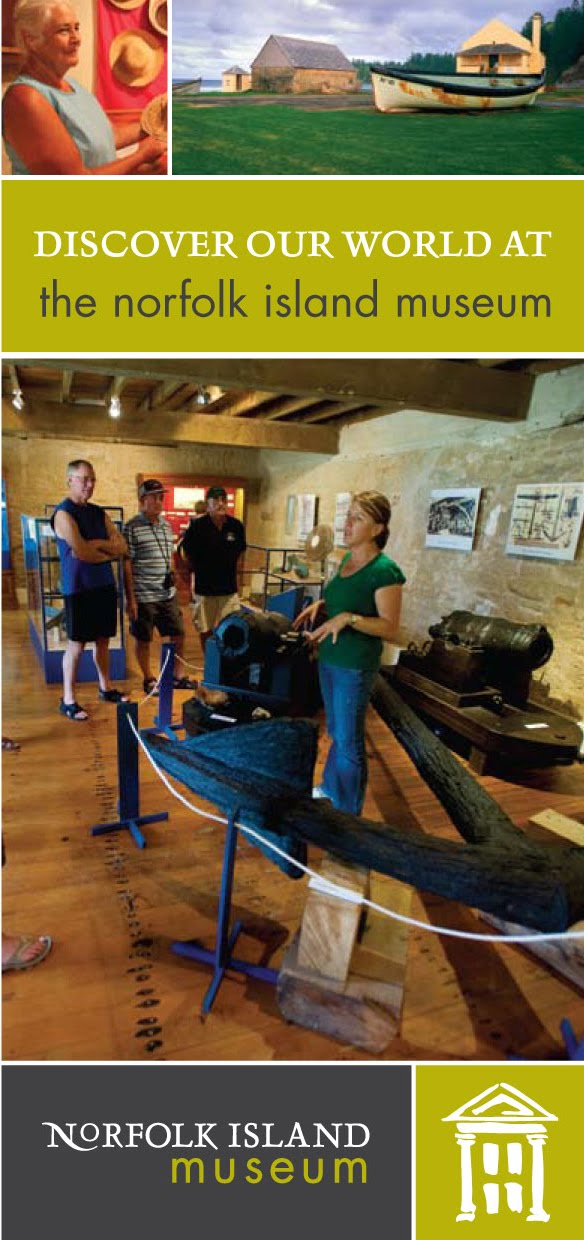 When the Norfolk Island Tourist Bureau unveiled the new branding for Norfolk Island towards the end of last year, they provided us with the opportunity to look afresh at how the Museum presents itself to visitors. We wanted to work with the new “World of Norfolk” brand and were really excited by the new colour palate provided by the creative team that worked on the “Welcome Back to Earth” tag line. When our brochures were due for a re-print earlier this year, we used that as the opportunity to apply a make-over to our logo and overall look to bring us in line with the brand.
We were very happy to work with local graphic designer Haylee Fieldes, now living in Perth. Haylee produced a new logo and style guide, brochure and flyers for us. Using the new logo, and with the help of Eve Semple's business Signed, we’ve also updated the sandwich boards that sit outside each of our Museum venues.
To say we are delighted with Haylee’s work is an understatement! She has provided us with a really great new logo which incorporates the door image from our old logo with new fonts and colours. The new brochures and flyers are vibrant and clear and are exactly how we want to present ourselves to visitors. As we produce nearly all our advertising and promotional material in-house, with the help of Haylee’s style guide we can use the key elements of the logo, font and colouring to make sure that everything is consistently presented so that our look is intact. Visitors should have no problems identifying our various products.


Subscribe to:
Posts (Atom)