Thursday, July 4, 2013

For Whom the Bell Tolls...


It has been wonderful to have our expert cemetery tour guide Mary Cooper back with us, if even for a short time. Mary developed our “For Whom the Bell Tolls…” cemetery tour and over the past few years has continued her research into the stories behind the graves in our amazing Norfolk Island cemetery. Over an hour and a half, the stories of each person build to provide a vivid overall picture of the islands settlements. We receive a lot of feedback about this tour that tells us it really ‘works’ – in content and delivery thanks to Mary’s passion, enthusiasm and hard work. It is easy to wander through the cemetery and ‘get a feel’ for it yourself, however a whole new appreciation can be gained with knowledge learnt about the graves through the tour. Two of the graves that we often visit are for men who died in the same accident.

Right down behind the back fence to the beach there are two large tombstones lying side by side. One is for Captain John Best and the other for John McLean who both perished along with a young soldier, when their boat was upturned while returning from a day of hunting rabbits at Phillip Island. However a letter to the “Australasian Chronicle” of Tuesday 17 March 1840 tells us that their drowning deaths were not the only ones that occurred that week and that an unusual rising of the sea was to blame:


To the Editor of the Australasian Chronicle
Sir – The Angel of Death has swept off four victims in an instant during this week. A prisoner, by name Atkinson, formerly clerk to Rev. Mr. Sharpe, and lately a constable at Government House, was drowned while fishing, - some men who saw him sink swam immediately to his relief, but in vain. His remains were found the next day, a mere skeleton – two arms and a leg gone, the bowels and flesh eaten away by sharks. This day, a boat returning from Phillip Island was upset and literally dashed to atoms, by a succession of tremendous rowlers, that came on suddenly and rather unexpected. The Hon. Captain Best, though a good swimmer and not four minutes in the water, was taken out lifeless. Surgeon Gaurie, 80th Regiment, instantly applied every measure to resuscitate animation; but the Captain must have been suffocated by a frock buttoned round his neck, which enveloped his head when upset by an awful wave. There was no water in his chest or lungs. Mr McLean clung to an oar, and was carried towards the blow hole, where no human being could get to his assistance. He remained on the oar at least half an hour before he sunk to rise no more. His body was found uninjured on Tuesday morning. Corporal McLoughlin, a worthy young soldier of the 50th, was lost on the upsetting of the boat; he was washed ashore the next morning. All were interred with due and melancholy honours.

At the same time our respected Commandant was ill of a bad fever, and not in a fit state to have this sad news communicated to him for more than a fortnight. Captain Few fulfilled the duties of Commandant during this time, and gave full satisfaction, till the arrival of Captain Maconochie.

The sea rose and subsided in about half an hour, when the destroying angel came on the wings of the wind on his errand of death. This sad an awful catastrophe has made a deep and I trust salutary impression on the minds of all, both free and bond. You may hear many exclaim, “May the Almighty prepare us for death – may he never cut us off unprepared, by such a sudden death”
An Eye-Witness
Norfolk Island, Feb 15, 1840.

The Cemetery Tour runs every Tuesday and Friday 11.30am to 1.00pm. Cost is $20 or, if you have a Museum Pass $15.00. It is not to be missed and booking can be made at any of the museum venues, the Tourist Bureau or Baunti Escapes.

Monday, July 1, 2013

H.M.S. Sirius Museum Officially Open


Lisle Snell MLA Chief Misinter and His Honour The Administrator Neil Pope
With the joint cutting of a cake by His Honour the Administrator Neil Pope and Lisle Snell Chief Minister, Norfolk’s newest museum was officially opened last Friday night. The H.M.S. Sirius Museum located in the former Protestant Chapel at Kingston celebrates and displays the artefacts and significance of the flagship of the First Fleet, wrecked on the reef at Slaughter Bay in 1790. Around 70 people witnessed the opening of this major new asset to the island that presents an important part of our heritage and history.

It was apt that the opening occur by both the Chief Minister and the Administrator as funding for the project was a 50-50 contribution that began with a successful application to the Commonwealths Your Community Heritage Program which was then matched by the Norfolk Island Government. The need to re-house the collection had been clear for the previous 8 years as artefacts had deteriorated in the environment of the Pier Store. The project spent 95% of its budget on local builders, suppliers and contractors and is a proud statement of the skill and expertise available within our local population.
 
Probably one of the single best decisions we made was asking graphic designer Haylee Fieldes to design our interpretation panels. Using her brother Matt’s wave photographs as a backdrop she has given us a fresh and contemporary look that gives the space a real WOW factor. Armed with Haylee’s work we then needed to get the images printed, onto panels and onto the walls. Thanks to Rob Nesbit’s investment in his 2899 Gallery we were able to print and mount the large scale prints on-island ready for adhering onto the timber backs. Charles and Kim at Christian-Bailey Agencies spent a lot of time nutting out supplies and getting everything onto the island just in time to fit our tight schedule. 

 There were a number of months spent preparing the building at the start of the project. After gaining EPBC approval to undertake internal building works, Gavin Snell at the Works Depot extended the old kitchen and pulled down the walls of a second room. Michael Porter and his All Star team then painted leaving us with sparkling new white walls. Wayne Pendleton was next, sanding back and re-surfacing the floor. Other suppliers and those involved were Norfolk Electrical, O’Hara Plasterers, People Peaples, Island Plumbing and Gas, Norfolk Island Building Supplies, The Trading Post and Timber on the Move.


Janelle Blucher and Lisa Richards
Amongst other things, Brentt Jones was responsible for building new cabinets which then received Perspex tops thanks to John and the guys at JCB cabinets. Steve Cochrane built other cabinets and also the frames for the window covers with material from The Upholstery Shop. Brentt and Basil Vercoe pulled out the historic setting of the Trial of the Fifteen at the start of the project. Greg and Pete Horrocks moved cabinets and replica hull pieces around and we hired space at Five Pines to cope with the coming and going of cabinets, stage settings and replica hull pieces. Once our replica hull had been put in place it was brought to life with the amazing painting skills of Noelene Nobbs, who also worked with us on the production line of assembling the interpretive panels.

Doug Creek, Works Supervisor
Lesley Warren and Nicky Beadman
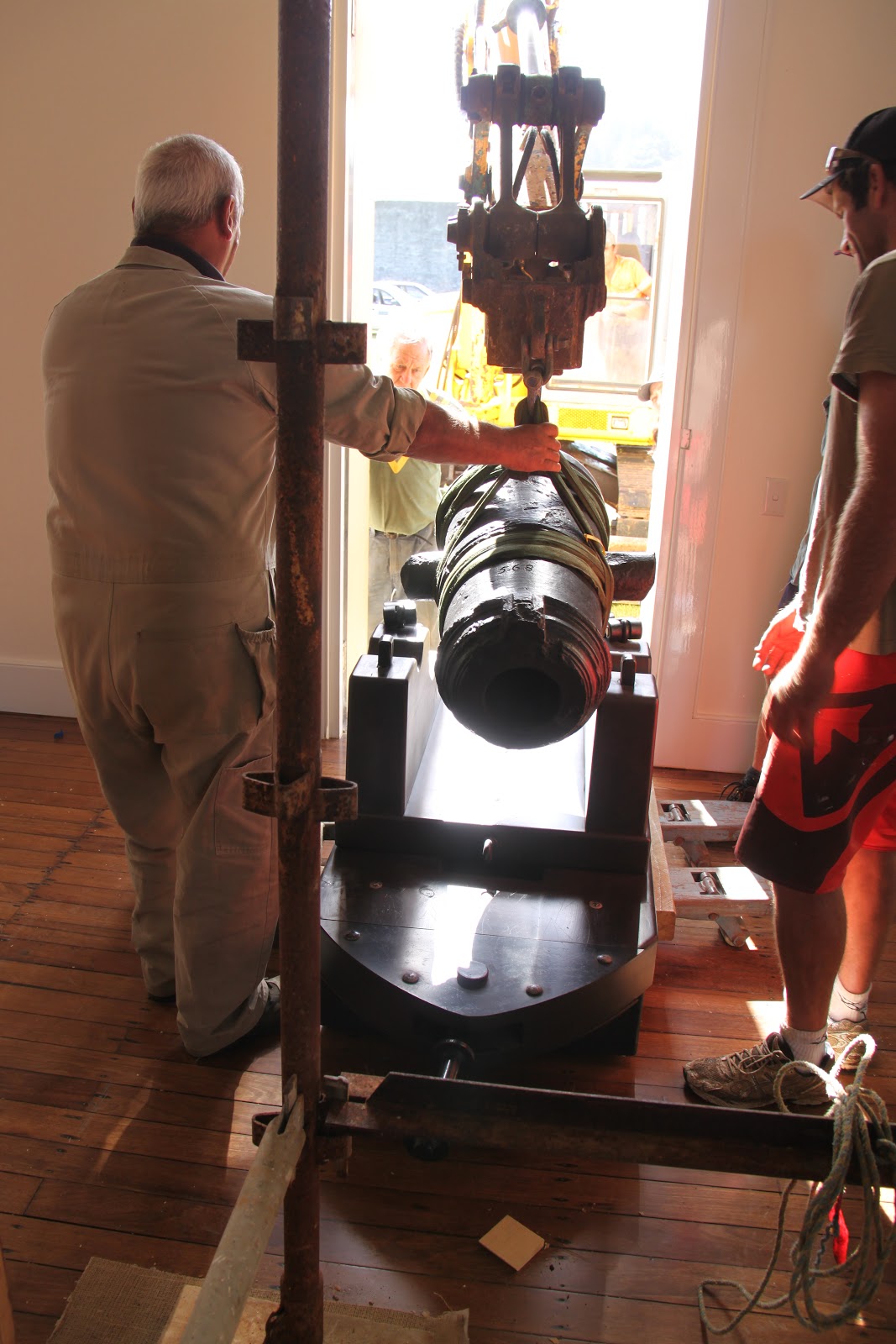
Without a doubt the most daunting aspect of this project was actually moving the artefacts themselves. The potential risk of damage occurring while moving these incredibly precious, but very big and heavy artefacts was high. With thanks to the Museum of Tropical Queensland, they agreed that Display Officer Phillip Smith be here for the move bringing his many years experience moving ‘hard to move’ objects. However these objects would simply not have been able to be moved without Franklin Randall who has been involved in every move of the anchor since its recovery from the sea floor in 1973. Together with Caine Henderson and his Dial A Digger crew of Winton Steven, Pumpkin and Brett Berganin and also Brentt Jones – they moved the entire collection within one day. It was an absolute privilege to watch them work and a great sense of pride to know that the skill to undertake such a job exists in our Norfolk men.
One of the things we purposely set out to do in the museum was to celebrate the approximately 1,500 people of the First Fleet and achieved this via a First Fleet Wall. Darren Bates took on the mammoth job of creating an individually inscribed plaque for each person that could then be sponsored and mounted by a descendant. Descendants can also sign our Descendant’s Books that provides a page for each person and an accumulation of signatures. Finally a touch-screen computer was set up by Linda ‘Chips’ Halcombe providing the opportunity to call up each person and read their biography.


Don and Sue Brian
The months of the re-housing project went smoothly due to the absolute support and hard work of all museum staff including Janelle Blucher, the cast of the Trial of the Fifteen and Director Rose Evans, Jeanine Snell, Andrea Greenwood, Mary Cooper, Helen Sampson, Rachael McConnell, Sallie Davie, Rebecca Hayes, Di Garner, Betty Matthews, Colleen White, Barb Elvey and Nat Grube. Volunteer Sue Brian worked nearly 4 days a week, every week with us on this project and then at night with Don!

We hope that the new H.M.S. Sirius museum will bring greater focus to Norfolk’s role from 1788 in the establishment of the new colony and what was to become Australia. We have the tangible evidence of that time on display - the most significant array of First Fleet cultural heritage held anywhere in the world. We have the potential to specifically bring more visitors to this island to visit this museum and celebrate the First Fleet and the role of the Sirius as the flagship.  
 

Please come and see our new museum any time between 11.00am and 3.00pm Monday to Saturday. We’d love to show you through!

Thursday, June 20, 2013

"Heart of a Beast" book signing


A few weeks ago we had the pleasure of meeting Brisbane author Josephine De Moor when she came to the island and signed copies of her new book “Heart of a Beast” which is set on Norfolk Island during the Second Settlement.  Josephine’s book brings the best that historical romance has to offer as while it is a gripping tale of jealousy, love and revenge it never compromises on historical accuracy. The name of the book was inspired by a quote from convict Robert Douglas, said to be one of the ring leaders of the 1834 mutiny on Norfolk: “Let a man’s heart be what it will when he comes here, his Man’s heart is taken from him, and he is given the heart of a Beast”.

There are so many aspects to Norfolk Island that spark creativity amongst artists and writers - whether it be the beauty of the island, the power of the stories of our history, the remnants of stone buildings, or hearing a conversation spoken in Norf’k amongst locals. Through her numerous visits to Norfolk Josephine has clearly been inspired by our history and captivated in particular with the brutal Second Settlement. Australian fiction with its convict past has been an all consuming passion for her since early childhood leading to volunteering at the Queensland Genealogical Society and thus helping many families discover their origins. Now the ruins of Kingston have inspired Josephine to find her own characters and give them life through her fabulous book.

The story is a sweeping romance and will especially appeal to those who enjoy the combination of historical fact with the fiction of a great love story.  The book’s back cover gives the best description of the story line: “In 1847 the love for a woman and a debt of honour threatens to destroy two men in the harsh penal colony of Norfolk Island. Driven by intense jealousy and guilt, Lieutenant Edmund Thornton sets out to destroy convicted felon, Michael Hanlon, both of whom share a love for Sarah Henshall. Her unexpected arrival on the island sets into motion a series of tragic events”.  

Josephine signed books at No. 10 Quality Row which was very apt as this is where much of the action of her novel takes place. Many visitors and locals really enjoyed meeting Josie whose warm and friendly personality meant many good conversations were had. For visitors and locals alike, this is a book that will inspire a new feeling when walking through Kingston and around the island, bringing part of our darkest convict history to life. How lovely to be able to have your own copy personally signed by the author! There are still some signed copies available for purchase at the Pier Store Museum.

Sunday, November 25, 2012

A Very Speical Loan


Next year the Norfolk Island Museum celebrates its 25th Anniversary. During the last few months we have been thinking about a range of things that we can do to celebrate this achievement, including displaying objects that will have special significance and meaning to the Norfolk Island community. We are very pleased to announce that a loan has been made with the Museum of Tropical Queensland for a quite special object that will be displayed throughout 2013.

The object is a Tahitian food pounder or pestle, or, as it was known in Tahiti, a penu. It was recovered from the wreck site of the Pandora and is thought to have been confiscated from one of the ‘other’ mutineers on the Bounty who did not sail on to Pitcairn Island with Fletcher Christian and the rest of the mutineers. The men it has been associated with are mutineers Peter Heywood and George Stewart who were taken into custody in Tahiti.
L-R: David Buffett, Lisa Richards, Phillip Smith

Heywood and Stewart along with another fourteen mutineers were captured in Tahiti after Captain Edward had been sent by the British Admiralty to find the Bounty ‘pirates’ and bring them home for trial and punishment.  The Pandora arrived at Tahiti on 23 March 1791. Within twenty-four hours eight of the mutineers had given themselves up leaving another six men at large (another two had been killed earlier in a feud). Armed parties were sent out to hunt them down and in a matter of days they were found.

On board the Pandora the mutineers were placed under arrest and shut in a specially built wooden box on the deck, measuring 11 by 18 feet (3.3 x 5.4 metres) and known as Pandora’s Box. This was unusually harsh treatment of prisoners at sea but Captain Edwards had a reputation amongst naval officers for brutality.

On the return voyage to England the Pandora was wrecked on the Great Barrier Reef. Thirty four men drowned including four mutineers, one of whom was unable to escape from the wooden box. George Stewart was amongst those that drowned.

The survivors of the shipwreck, including ten mutineers, finally reached Timor in open boats following the route taken by Bligh in the longboats. When they arrived back in England the captives were imprisoned to await trial for mutiny. Four of the mutineers were pardoned following written evidence by Bligh that they only remained on board the Bounty because there was no more room in the longboat. The remaining six were sentenced to death. Peter Haywood and William Morrison were pardoned. William Musprat was released on a technicality but three mutineers Thomas Ellison, Thomas Burkitt and John Millwood were hanged in October 1792.

The simple and beautiful pounder that will be on display in the Pier Store was used to mash, amongst other things taro, which is cooked and then fermented to become a starchy food staple called poi. It would also have been used to pound breadfruit and bananas.

Phillip Smith from the Museum of Tropical Queensland very kindly brought the pounder to Norfolk with him when he travelled here to work on the HMS Sirius collection re-housing project. Prior to departing last weekend he presented it to the Norfolk Island Museum in the presence of the Chief Minister, and Minister for the Museum, Mr David Buffett.

We are very thankful to the Museum of Tropical Queensland for their support in helping us secure this loan. It is not yet on display as the finishing touches to a display case take place however it will be within the next few weeks and will be found on the ground floor of the Pier Store Museum. As a result of the removal of the HMS Sirius collection from the Pier Store, both floors of the building now display the Bounty story and artefacts together with the stories of Pitcairn Island and Norfolk Island. It is a museum that celebrates the history, stories and culture of the people of Norfolk Island. We hope that many people will enjoy viewing the pounder with its special connection to Norfolk’s foremothers and fathers.

Wednesday, November 21, 2012

The HMS Sirius Collection is Moved!


It has been a big few weeks at the museum. On Thursday 8th November the amazing team of Phillip Smith, Franklin Randall, Caine Henderson, Winton Stephens, Brent Jones, Pumpkin and Brett Berganin took the Sirius anchor, carronades and other artefacts from the Pier Store to their new home in the former Protestant Chapel. This was no easy task for the anchor in particular. Not only did they have to take the 1.7 ton anchor out through the gantry doors in the Pier Store (that are shorter than the average door and thinner than the width of the head of the anchor) they also then had to manoeuvre it in through the compound side door, attach it to a wooden stock and leave it free standing in the middle of the room! Hopefully some of the pictures will reveal the level of skill and ingenuity required to successfully carry this out.

Our sincere thanks to Franklin Randall for doing it all again! and providing his expert knowledge to the whole process. Caine Henderson brought his ‘Dial a Digger’ machinery and team who worked together for the entire day meeting every challenge without a hitch. What amazing Norfolk men!


We have been so lucky to secure the services of Phillip Smith from the Museum of Tropical Queensland who has so much experience with this type of work. Prior to the move of the major artefacts, Phillip worked with Brent Jones putting up the 5 metre long replica fibre-glass hull. Fitting the difficult bow sprit and figurehead were no problem for these two! Phillip and Brent will continue working on this museum and the Pier Store through next week as all the interpretation panels are hung and new displays installed in the Pier Store. As always we had our amazing volunteer Sue Brian doing anything and everything and more that was asked of her.

 This exciting re-housing of the HMS Sirius collection is of course only possible due to funding from a grant through the Commonwealth Your Community Heritage Program and the Norfolk Island Government. We have a long way still to go before the new museum will open its doors – but the major and most difficult task of moving those precious artefacts has been successfully achieved.

The photo's really capture the action, skill and incredible accomplishment of the 'move team'. 


Tuesday, November 6, 2012

The Move - Day 2

The move of the HMS Sirius collection continues. We had a great day yesterday as the anchor stock and cabinets were delivered to the museum and the replica hull had the bowsprit attached. Our 'full-time' team of Phillip Smith from the Museum of Tropical Queensland, Brent Jones, Sue Brian, Janelle Blucher and Lisa Richards were on hand - and also Franklin Randall from KAVHA and Caine Henderson from Dial a Digger! Caine's team will be also be managing the move of the major items such as the anchor and carronades on Thursday.

The following pictures tell the story of the day:


Monday, November 5, 2012

We're on the Move!


All of the work of the last five months is coming to a head this week and next as the HMS Sirius collection is moved into the Protestant Chapel. This “HMS Sirius Collection – Re-housing Project” has been made possible with funding through the Commonwealth’s Your Community Heritage Program and the Norfolk Island Government. It is a very large and exciting project and one that will importantly result in the Nationally Significant HMS Sirius collection being housed in vastly improved environmental conditions. As the flagship of the First Fleet, the Sirius is Australia’s most important shipwreck and as a result of this project Norfolk Island will have a dedicated museum to display her story and remains.

A lot of work has been undertaken to get us to this point. The building has been modified to include a workroom/office, painted and had the floors sanded and re-sealed. New interpretation panels have been designed, written, printed and mounted onto backing panels. Cabinets have been custom made and the replica hull that stood in the old museum has been cleaned up ready to be installed. The anchor stock has been cleaned and oiled ready to stand once again attached to the anchor. A touch-screen with a database on all of the nearly 1,400 people of the First Fleet is underway as is a First Fleet Wall that will eventually contain individually inscribed wooden disks for each of the 1,400.

Not only that, but new displays have also been developed to fill the ground floor of the Pier Store which will be left empty when the Sirius collection is moved out. The Pier Store will be closed for a period towards the end of next week and will then re-open with a focus on the stories of the mutiny on the Bounty, Pitcairn Island and Norfolk Island from 1856.

Phillip Smith from the Museum of Tropical Queensland (MTQ) has arrived to work with our local men on the move. Phillip was last here in 2010 to build a fibreglass replica Bounty cannon used while we completed conservation work on the original. At the MTQ he is a Display Officer with responsibility for the mounting of displays and moving objects throughout the museum. He is also a specialist in dinosaur creations! He recently made a life size replica dinosaur that moved by remote control to the delight of children visiting the museum’s dinosaur exhibition. We are excited to welcome Phillip back to the island and to work on this important project. Our sincere thanks to the MTQ for releasing him from his work and allowing him to come – and also to his wife Claudia and small son Lennox for letting us take him away from home for the fortnight!