Monday, March 19, 2012

Artefacts from the AV Resolution


One of the current projects at the Norfolk Island Museum is to research stories and artefacts relating to the Resolution, a locally built schooner launched from Emily Bay in December 1925. Between 1923 and 1925 a number of men were engaged in her construction. The Resolution was the fulfilment of the Norfolk Islanders dream – to own a vessel of their own to trade between Norfolk and New Zealand. It proved to be a dream realised and lost as on her maiden voyage, laden with home-grown produce, she was becalmed and the cargo spoilt. Future debts meant that she was sold in 1927 to Burns Philp and Company and was used in the Tongan, Fijian and New Hebridean trades until she sunk at her moorings in Port Vila Harbour in 1949.
The Resolution Bell

Many people have beaten down this pathway in the past and have come up with invaluable information. Revisiting research some 20 years later using the web will hopefully uncover some additional information relating to this story that has such high social significance amongst islanders today.  Scanning through digitised newspapers of the Australian National Library, we read the following article featured in “The Register” Adelaide 11 May 1926, “New Zealand Adventurer” Auckland (N.Z.) Monday.  Manned by a crew, the members of which admit they have only a very elementary idea of navigation, the launch Koa left Auckland on Saturday for Norfolk Island, via Bay of Islands, to await the arrival of the auxiliary schooner Resolution, which is proceeding to Norfolk Island this week.  The Resolution will set the course, and be followed by the launch, which is 42ft long.  The launch, which has taken a weeks provision, is to be used in the whaling industry.  Her owner, Mr. V. Harrison is commanding her.

Communications between interested parties in Norfolk Island, Vanuatu and New Zealand resulted with the discovery of the ship’s bell and wheel and the eventual return of these two significant items to the people of Norfolk Island.   The recovery and return of these two items from the shipwreck is well documented, however their actual origins remain elusive.   Where did the bell and wheel come from?  It is known that a philanthropic lady assisted with finance towards the construction of the ship and later the engine; we don’t know her name.  Does anyone know of any thread of a story that may lead us to finding out how these two valued objects may have arrived on Norfolk Island to be fitted on this ship?  

The Resolution shortly before being launched in Emily Bay in 1925

Tuesday, March 6, 2012

1899 Council of Elders Letter Returns to Norfolk Island


Working at the Norfolk Island Museum we are in the privileged position of dealing every day with the stories of this island. Every now and then we receive new objects or information that brings to light yet another chapter or event that has occurred here. This week we received a letter from the USA that has opened up one of those new chapters.

The letter we received was written in 1899 and signed by John Buffett, President of the Council of Elders. It was sent to the Chief Magistrate Charles McArthur King and from there most likely ended up in a file in one of the buildings in Kingston. During WWII it was taken from Norfolk when a visiting American naval man somehow ended up with it and kept it as a souvenir of the island. He told his family that he found ‘the place’ abandoned (perhaps the place where the letter was found) and kept it as a keepsake.

Nearly 70 years later the sailor’s son, Terry Thomas of Massachusetts USA, emailed me to ask if we would be interested in the letters return. Headed Council of Elders and dated 25th November 1899 it reads:
“Sir,
I have the honour to inform you that the following resolution, after much consideration, was passed at a meeting of this Council on the 21st instant – the motion ran as follows: -
“That a letter be sent to the Chief Magistrate complaining of the manner in which Colonel Spalding is allowed to hold and utilise land contrary to the privilege allowed to any other inhabitant”. The idea of the resolution is that if Colonel Spalding is allowed to do these things why can’t the same privilege be granted to the other inhabitants, as the law stands it appears to me to be one sided.
I am Sir
Your Obedient Servant
John Buffett
President
C. McA King Esq
Chief Magistrate

Chief Magistrate King has noted in the margin “please mention what the subjects of your complaint are” and signed his name.

The letter was written during a time of significant tension and change on the island. Three years before the island had had its full administration taken over by NSW. This formally occurred on the 14th November 1896 when NSW Governor Hampden landed on the island and called for a public meeting to occur that afternoon at 3.00pm. There he proclaimed the new laws and regulations of the island which meant that the domestic affairs that the Islanders had been in control of were taken out of their hands. Under the new laws the office of Chief Magistrate became a government appointment and was not subsequently filled by an islander. In reality the islanders had lost self governance.  At the meeting Hampden installed Colonel W.W. Spalding as Chief Magistrate, Spalding’s son Lieut. W Spalding as Clerk of Courts and John Knuckey as sergeant of Police.

Spalding was appointed with a salary of £25 per month. However from the very start of his appointment there was discontent with both Spalding and his son and petitions were sent for his removal. In 1898 the chief inspector of Public Accounts GE Brodie arrived on the island to investigate financial matters and found that the island’s books were not kept in orderly fashion and that the Chief Magistrate - Colonel Spalding – was putting certain fines and fees to his own use, he contending that they were prerequisites to which he was entitled. There were charges too that in administration of justice he was leaning to his friends.

Information compiled by Claude Dillon in 1957 from the Manuscripts Library and in our files says Spalding’s son was found to have broken the moral code and the Sergeant of Police had abused his authority, got a girl into trouble, and stole away from the Island in the ‘Ysabel’ and left debts unpaid for! Dillon says: “The Government did not feel inclined to openly discharge Spalding as the Islanders would regard it as a victory. The three officials to whom the Government had entrusted the affairs of the Island under the new order did not set a good example and the islanders, in a well signed petition seeking the withdrawal of Spalding, did not fail to comment adversely, pointing out that under the 1896 code they were faced with proceedings against them for offending against the laws and they saw no valid reason why a Government appointee should not be charged”.

Spalding had secured land whilst chief magistrate and surprisingly continued to farm on the island for some years after he was removed from office. No doubt, this is what the Council of Elders letter of complaint is about. As the next chief magistrate and the person to receive the letter of complaint, Charles Macarthur King also brought to the island a connection with the first penal settlement (1788-1814) as he was the grandson of Philip Gidley King, the first Commandant of the island.

There is another story still to be fully investigated and told regarding the circumstances of Terry’s father here on Norfolk Island during WWII. All we know so far is that he was with the ship S.S. Nichols, which we haven’t been able to research as yet. If anyone has any information we would love to receive it.

Monday, February 27, 2012

Conservation of the Try Pot

Janelle Blucher has been very busy over the past week getting stuck into conservation work on one of the try pots upstairs in the Pitcairn Norfolk Gallery. The work is included in a Post 1856 Maritime Project funded by a grant from the Maritime Museums of Australia program Support Scheme (MMAPSS). This project will overhaul our whaling and Resolution stories on display in the Pitcairn/Norfolk Gallery in the Pier Store.

The pot’s later life was connected to Norfolk’s whaling days as it was used during the 1880s to render down whale blubber for oil. During the 19th Century the conversion of blubber to oil, or try-out work, was done in round bodied, large mouthed iron cauldrons of 150 to 250 gallons capacity. The cauldron was placed on either an iron or brick base forming a small furnace into which was added a fire box. Once heated, sections of whale blubber and meat were placed into the pots and rendered down, this practice continued until the pot was full of oil. The oil was then extracted from the try pot and placed in cooling tanks or kegs. The method employed on the island during the 19th Century was often crude, with no attempt at refining or grading the oil. This caused overseas consignees to complain of uneven quality and bad colour.

While we now describe the pot as a try pot, using its more modern purpose to describe it, it was originally a boiler used during the Second Settlement. The pot bears the marks B ↑ O and the date 1846. The BO stands for Board of Ordinance and the arrow is of course, the broad arrow marking government ownership. Cooks used the pot to prepare meals for the convicts, with the fat from boiling meat floating to the surface. British naval traditions were that each mess of six men had their food (salted meat or dumplings) boiled in a bag tied with an identifying tag. A man from each mess was delegated to collect and serve up the food to his group.

During the past few weeks Janelle has been using mostly manual methods to remove corrosion – hand brushing with a wire brush. The pot has quite a large crack in the base making it very difficult to work with and it’s unable to be moved for fear of the crack enlarging. There’s not a lot of room between the floor and the bottom of the pot resting on wooden chocks, so Janelle has had to quite creative developing methods to get into the hard to get at places! She has applied a corrosion converter to the inside and will do the same to the outside next week. As there are some areas she literally can’t get at right underneath the pot, she will wait to be satisfied with the state of the metal before she decides wether it needs a protective coating or not.

Monday, February 20, 2012

70th Anniversary of Norfolk Island Airstrip


Christmas Day this year will mark the 70th Anniversary of the first ‘unofficial’ landing of an RNZAF plane on the Norfolk Island airstrip. The plane delivered food and Christmas parcels to the Kiwi forces stationed here during the war and no doubt took some of the limelight from the first official landing of two Hudson bombers on the 28th December. Three more planes landed the following day. The drama, and excitement, of war was well and truly upon the island. Throughout the duration of the war, an average of 200 planes a month staged through Norfolk, bringing sixteen different types of aircraft.

While today it is almost impossible to imagine coming here any other way than by air, up until 1942 the only option was by ship. No enemy invasion occurred on Norfolk during the war. However the impact to the island was possibly far greater than any previous event, leaving profound changes that are still with us today. The airstrip opened up the island to the outside world like never before.

It was Japan’s entry into the war in 1940 that dramatically changed the island’s war time role. To begin, a small Australian detachment of fifty-seven men was dispatched to reinforce the local detachment and prevent sabotage of the cable station at Anson Bay. This was where the cable from New Zealand joined the Pacific Cable, linking Australia and Canada via Fiji.

However it was Norfolk’s unique and strategic position in the South Pacific that brought her fully into the war. The US Navy & South Pacific Commander, Vice-Admiral RL Ghormley decided that an airstrip would be ideally located here. It would be a staging depot for land-based aircraft moving over the waters between New Zealand, Australia, New Caledonia and the Solomons; a base for anti-submarine patrols, and refuge for aircraft in distress. With an airstrip, Norfolk would have a role as a centre for maritime reconnaissance and surveillance.

The site was chosen on the south western side of the island. In total 171 ha of land was compulsorily acquired, representing one eighth of the island’s total area - a vast amount of land to be given by Islanders for the furtherance of the war effort. Aside from the removal of many family homes, the “Tree of Knowledge”, a large tree where local notices were historically posted was also removed, along with one mile of historic 30 metre high convict planted pines known as “The Pine Avenue”. With the enormous impact to so many families, it is hard to imagine the land being able to be acquired in any other circumstances than war.  

A New Zealand company, the 36th Battalion designated as ‘N Force’, made up of 1,488 personnel was dispatched to protect the airfield. N Force also comprised the 215 Composite Anti-aircraft Battery, 152nd Heavy Battery and a mobile field troop. They were stationed here between 1942 and 1944 and as a result, Norfolk’s war history is closely tied to New Zealand.

The overall effect on Norfolk was enormous. The local population at times was outnumbered by 3:1 from military personnel, with a peak of 2,000 servicemen in the first half of 1943. This brought the island population to its highest ever, impacting on the availability of fresh food. Roads were widened and re-built. A 20 bed hospital was constructed. Islanders’ homes and the Old Military Barracks at Kingston were converted for war-time use. A disused sawmill was put back into operation producing 65,000 superficial feet of timber per month (ultimately leading to a significant loss of timber reserves). And a radar station was built at Mount Bates by the RNZAF in May 1943 serving to save both lives and aircraft.

The photo is of the first official landing and is from the Road Transport Authority. There are plans to mark the 70th anniversary at the end of the year with exhibitions and displays and other events. The story of the making of the strip, its war time use and post war impact on the island is a big story. As the details emerge we’ll keep you posted.

Monday, February 6, 2012

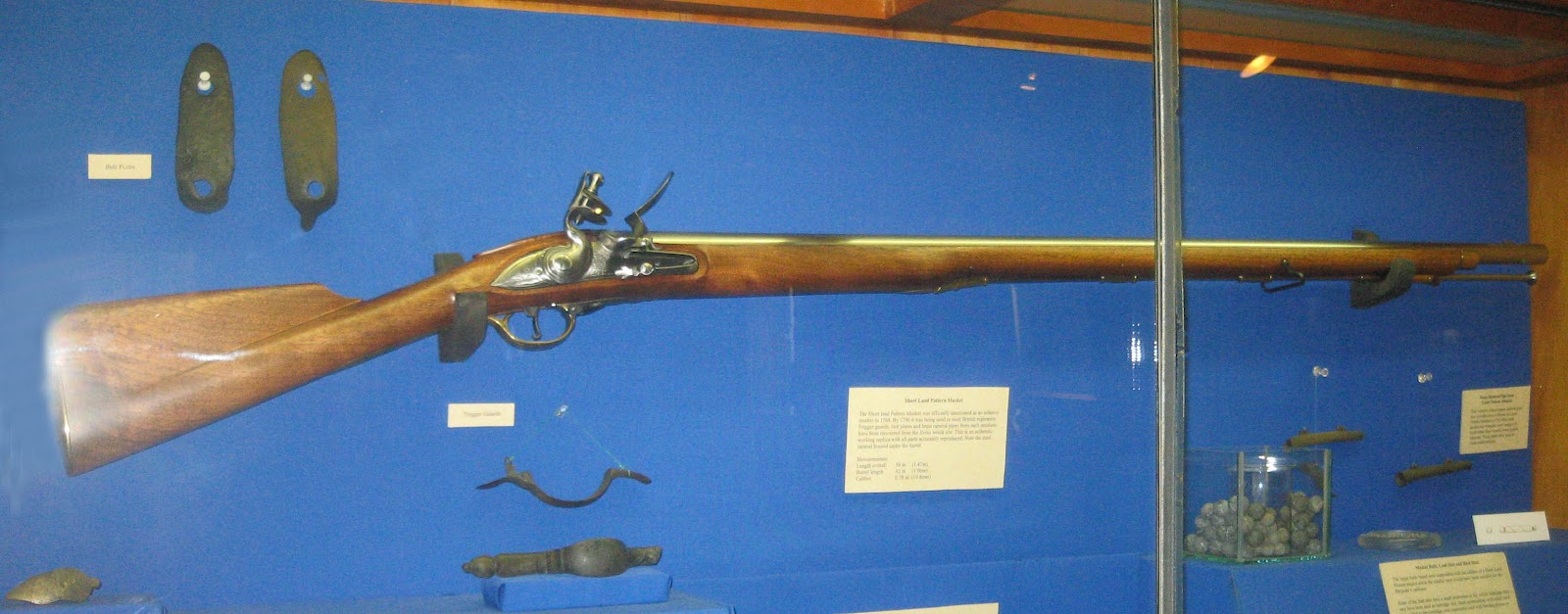
Short Land Pattern Musket


The International Clay Target Championships are being held this week on Norfolk Island and the shooters may enjoy reading about a very special musket on display in the Pier Store Museum. We have a replica brown bess musket, officially known as a Short Land Pattern Musket on display with our HMS Sirius collection. During the Sirius expeditions recovering artefacts from the wreck site of HMS Sirius Flagship of the First Fleet, a number of brass fittings from this type of musket were found. The replica helps with understanding exactly where they came from on the gun. Myra Stanbury includes the following information the Short Pattern musket in the illustrated catalogue of Sirius artefacts. 


At the time that the Sirius set sail from England, Short Land Pattern flintlock muskets were standard issue for troops, although in practice both Long and Short Land muskets may have been supplied. The Land Pattern series of muskets had been introduced c1730 and served as the basic pattern for British service muskets until the outbreak of the French Revolutionary Wars in 1793. The Short Pattern was officially sanctioned in 1768 and by 1790 had become the standard infantry musket of the British Army.

The overall length of the musket was 581/8 in (1.5m), the barrel length 42 in (1.06m), and the calibre 0.78 in (19.8mm). Brass furniture for firearms was manufactured by brass founders in London or Birmingham according to patterns issued by the Board of Ordinance. The finished components would be sent either to the board’s contractors or directly to the central depot, the Tower of London. From there, sets of components were distributed to a relatively small number of London gun makers known as ‘rough stockers and setters up’ who smoothed and finished the rough wooden stock blanks and assembled the weapons. The First Fleet took along 200 Short Land muskets and twelve sergeants’ carbines, probably Grenadier Sergeants’ Carbines with bayonets, for the marines.

Three brass ramrod pipes, two trigger guards, two butt plates and a wrist eschutcheon were all recovered from the wreck site. Our replica was made in the USA and took several months to arrive due to strict controls on the carriage of weapons aboard aircraft. It is a beautiful piece that shooters and non-shooters alike can appreciate. It helps us to perhaps picture a marine or soldier in 1790, standing on the deck of the Sirius and loosing their musket overboard at that terrible time of impact as the wrecking occurred.

Monday, January 23, 2012

Volunteer Work Behind the Scenes


Every Friday Helen Price volunteers her time to the Museum and travels up to our main store and conservation area to work on objects in the collection. As she is a trained conservator we are extraordinarily lucky to have available to us her skill and knowledge.

Helen has worked with many objects but in particular has created custom-made housings for objects kept in the main store.  Obviously if an object is badly stored and handled it will lead to damage and deterioration occurring. For objects that are already fragile and in a poor condition it is even more important to ensure they are properly supported while ‘sitting’ on a shelf. Helen has made housings for, amongst other things, books, uniforms, hats, bags and jewellery. She has made boxes with multiple compartments for HMS Sirius artefacts that are works of art in their own right!

Recently, the museum made the decision to ask Helen to make boxes for the valuable Births, Deaths and Marriages and other records such as Land Titles, held in Registry at Kingston. These BDM records date back to 1882 and an earlier, The Pitcairn Island Clerical Register, dates 1853-1882. The books are historical artefacts, but they also need to be accessed by staff in their work at Registry. Of course, regular handling pulling them on and off shelves and opening the pages and limited storage options has led to damage occurring and many are in a very fragile state. Scanning of the records has occurred so the original documents do not need to be handled often, but they still need to be accessed from time to time and they need to be stored correctly. Helen has begun creating custom made boxes for each of the record books and she has designed them so that the book does not have to be taken out of the box to be read – the box always stays as a support behind the book and the pages are able to be turned within its protective walls.

The acid free board that is used to make the boxes is expensive and the museum has a limited supply. However we felt that these records though not part of our collection and responsibility, were too valuable to risk losing and that it was important that they be attended to. Of course, the job is only able to be carried out with Helen’s expertise and voluntary effort available to us. At some stage in the future it would be wonderful to give them a proper home where sufficient space and proper environmental conditions were available. Re-binding is also an option – but one far beyond our means at present. In the meantime, we are pleased to be able to support Registry staff with their handling and storage of these important documents that record so much of life on this island since 1856.

Sunday, January 22, 2012

Thomas Saulsby Wright


Twice a week on Tuesdays and Fridays at 11.30am, the museum runs a tour of the Norfolk Island Cemetery called “For Whom the Bells Tolls...” This is the only dedicated cemetery tour on offer on the island and over the course of an hour and a half we are able to really explore the amazing stories of the people who have lived and died on this island.

The grizzly stories of punishment, riot and execution in the Second Settlement are aplenty and are marked by the graves of men who died at very young ages. However there is one headstone from that period that stands out because of the old age of the person and it reveals a very unusual story. Thomas Saulsby Wright, a convict, died on the 7th February 1843 at 105 years old. When we learn that he was convicted of forgery we might question his age, but it is correct and he was 105 when he passed away!

Wright, alias ‘Tommy the Banker’ (he had worked for years as a banker), was originally sentenced to death for forgery in 1799 then aged in his sixties, but this was commuted to a life sentence and he was transported to Sydney where he was eventually pardoned. However aged 102 he was again caught with forged bank notes – and was transported to Norfolk Island with a sentence of 14 years imprisonment!

The Australian newspaper of 9th November 1839 tells the story of his trial and is recorded by Frank Clune in his book “The Norfolk Island Story”. The report includes that the court heard that Tommy the Banker pleaded not guilty, even though “A search warrant was issued, and the constable found several notes on Wright’s person, and in his house one hundred and ninety-one 10 pound notes, two hundred and fifty 5 pound notes, three hundred and seventy-six 2 pound notes, eighty-seven 1 pound notes and one hundred and ninety-five 20 pound notes, amounting in all to 8,000 pounds”. Plates were also found for a ‘Parramatta Banking’ company, a ‘Parramatta Trading company’ and another company “termed a ‘Defiance Company’, which he presumed had been jocularly so-called, because it was intended to set the law at defiance by fraudulent dealing”. Wright’s notes were from the Austilin Bank (perhaps he meant A-stealing!). The Attorney-General admitted that the plates were so well executed that any one would be likely to be deceived by their close resemblance to the notes of the Bank of Australia.

The judge asked Wright what he was doing with the notes and the Australian reports: “The prisoner…said that he had been sixty-two years a banker; he had undertaken to establish a bank for a company at Parramatta, but that he got connected with a party of swindlers, who robbed him. He was able to take up all his own notes signed by himself…and in fine that he had as good a right to establish a bank as any other gentleman…’Laughter in Court’, reported the Australian!

However Thomas Saulsby is probably still chucking in his grave as one of his forged bank notes appeared at an Australian auction house in late 2009. The auctioneer was originally very excited – perhaps this was the earliest Australian bank note ever found! However it was a one pound note, issued by the Austilin Bank and signed by Thomas Saulsby himself. After checking out the details of his time on Norfolk Island with Tom Lloyd, the auction house went on to sell the note for $30,000! The only thing he may be unhappy about is that 'Saulsby' was incorrectly spelt on his headstone as 'Saulsbury'.

There are many more amazing stories revealed during the Cemetery tour which runs from 11.30am to 1.00pm every Tuesday and Friday. The cost is $20 or reduced to $15 if a Museum Pass has also been purchased.