Showing posts with label Bounty. Show all posts

Thursday, July 12, 2012

Maritime Week on Norfolk Island


Next March the Norfolk Island Museum will be partnering with The Travel Centre to present a week long event that celebrates our maritime heritage. Despite being such a little island we certainly hit above our weight when it comes to the quality of our maritime stories and it is wonderful to be able to share these with our visitors  in a ‘history soaked’ week of events! The Travel Centre has put together a fabulous package including airfares, accommodation and a range of activities for the week which will run from 15 to 24 March next year. Please help us tell others about this event by letting us know of individuals or groups who may like to receive information about the week and we’ll arrange for a package to be sent to them.

The title of the week: “From the Sirius to the Bounty” gives a clear indication of the substance of our maritime heritage. These two ‘big’ maritime stories bookend other perhaps lesser known but also fascinating parts of our maritime history. The story of the earliest Polynesian seafarers who lived here is important as this island is the only point of Polynesian settlement in Australia. Many islanders today have found artefacts such as stone adzes in their back garden or at the beach and of course we have a great array of artefacts from the archaeological digs behind Emily Bay. How the Polynesians came, why and when they left are just some of the questions surrounding this earliest part of the islands history.

Jumping forward in time an important part of our heritage today comes from our whaling history. One of the first industries to be started upon arrival by the Pitcairners, whaling brought vital cash into the economy. It was a dangerous activity as evidenced by the number of graves in our cemetery and an industry that stopped and started a number of times until finally finishing in 1962. The Resolution is another key local maritime story that goes to the heart of this island’s ultimately unsuccessful attempts to control shipping of fresh fruit and vegetables to mainland markets. Our modern day lighterage activity and the skill of our local men in unloading ships attracts visitors to every unloading. All these stories will be fully explored during the week.

Of course the wrecking of HMS Sirius on Norfolk Island in 1790 left us with Australia’s most important shipwreck site and material. On the 223rd anniversary of her wrecking at midday the 19th March, we will be looking out over the site where the devastating wrecking occurred. The importance of her artefacts cannot be understated – they are the most significant array of First Fleet cultural heritage held in Australia.

Last, but certainly not least is the most famous mutiny story ever told – the mutiny on the Bounty. We will try to separate Hollywood fiction from fact and fully explore all the circumstances of the mutiny; that most remarkable voyage of Bligh in the longboat and the voyage of the mutineers back through Tahiti and eventually on to Pitcairn Island.

It would be hard to think of a greater spread of substantial maritime stories that our own island has. We look forward to partnering with The Travel Centre for Maritime Week on Norfolk Island next March – and hope you’ll help spread the word to potential visitors

Sunday, October 30, 2011

A Very Special Lamp


Late on a Friday afternoon a few months ago two visitors to the island called into my office asking to speak to me. Bob and Penny Burgess were here on holiday, but had also come to the island with the aim of arranging for a very special lamp that they own to come to Norfolk Island for an extended loan. The Burgess’ had been told that their lamp had been taken from Captain Bligh’s cabin just before the Bounty was burnt on Pitcairn Island in 1790. After having it hang in their house for over 20 years, they believed that it had such great historical and special significance that it should return to Norfolk Island for all to see. They generously offered for the museum to hold it for the next 5 years. 

 Bob and Penny were given the lamp about 1990 from the widow of Mr Ted (Edward) Winter. She and Ted were fairly regular visitors to Norfolk Island during the 1950's and 1960's. Ted worked in Sydney on Sydney Harbour possibly with the Maritime Services and when they visited Norfolk, Ted would do handyman work for Lavinia Christine (Donkin then Roberts) Nobbs, better known as Aunty Kit. She lived at Moira and together with her sister Val, ran the shop on New Farm Road. The Winter’s would stay with Aunty Kit on their visits and became quite friendly. She told them that the lamp was given to Fletcher Christian’s granddaughter Sarah who married George Hunn Nobbs and it was handed down through the Nobbs family until it came into Aunty Kit’s possession. At some time in the 1960s she gave the lamp to the Winter’s and they took it home to Australia with them. After Ted passed away Mrs Winter gave it to their friends Bob and Penny, who describe themselves as “collectors of everything!”  Bob and Penny have been wonderful custodians of the lamp as they have kept it safe and in very good order over the years.

However, it now appears that the lamp is not “the Bounty lamp”. Nigel Erskine, a former Norfolk Island Museum curator and someone very familiar with Bounty artefacts, inspected the lamp at the Australian National Maritime Museum, where he now works. Nigel dates it as mid to late 19th century and describes it as a high status lamp, unlike one that would be carried on a ship, but possibly could have been a church lamp. It is a very fine piece with three (originally four) glass panels that are flashed ruby/clear, most likely acid etched. The design on the glass includes a griffin – which is included in the Bligh family crest - another factor leading to a belief of ownership by Bligh. Another confusing feature of the lamp is that one of the glass designs includes a fleur-de-lis which is a French decorative item not usually found on English objects.

 This wonderful lamp has now come back to Norfolk Island and will be with us for the next five years. Its story is a mystery that we want to try and reveal. When did it first come to Norfolk Island and who brought it here? Perhaps it came with the building of St Barnabas or through other ecclesiastical contacts of George Hunn Nobbs? Perhaps it hung in Branka House when Fletcher Nobbs and Sarah lived there, or did it come to Moira at a later time? We will research to try and date it more precisely looking at details such as the making of the glass and its design elements. However it may be that there are people on the island who remember the lamp hanging at Moria or someplace else. We would be most grateful to speak to anyone who remembers it or has any information. Please call me on 23788 or 51434.

Tuesday, August 31, 2010

Back to Taking off the Surface Coating

If you've been following the story of our Bounty cannon conservation project, you'll know that last week we had great success removing the surface coatings. The coatings were applied by the Western Australian Maritime Museum in the 1980s when the cannon received treatment in WA. The coatings are Kephos primer, F & T Imerite 390 and polyurethane which our Conservation Officer Janelle Blucher, removed with Kwik Strip.


Late last week Janelle and Sue Brian (our wonder volunteer) began the process of removing surface corrosion and applying rusticide. This involved several days of working with a magnifying glass, wire brush and scalpel, slowly working their way away across the entire surface. The good news at that point was that the level of corrosion was less than anticipated, and with advice from Karina Acton from International Conservation Services, there would be no need to immerse the cannon in a solution tank.


However our good progress was interrupted early this morning. With a strong light, Janelle could see that there were still microscopic spots of the surface coating still intact. This means that we will have to go back to the  process of applying Kwik Strip then brushing and washing it off and carefully picking away at every inch of the surface. This is extremely detailed work and will require many hours of work. But it is necessary to make sure that all the old coatings have been removed before new ones are applied. This really just re-inforces for us the point that conservation work is usually detailed, hardly ever straight forward and a process of determining an action, gently seeing how it goes and moving on one step at a time from there. 


Sunday, August 22, 2010

Conservation Work Begins

What a fantastic two weeks we had with Phillip Smith from the Museum of Tropical Queensland, over here to make a replica of our Bounty cannon before conservation work begins today. Phillip, his wife Claudia and son Lennox left us on Saturday returning home to Townsville. We were so lucky to have had Phillip over to do this work, not only is he an expert in this area but he fitted in to the Norfolk way so easily. We really look forward to a lasting relationship with Phillip and the Museum of Tropical Queensland.
The final product - a perfect replica of the Bounty cannon

So the replica is now on display in the Pitcairn Norfolk Gallery at the Pier Store Museum. Lee Irvine finished off the painting - and except for the label, visitors would not know the difference! The story now moves to the conservation work to be carried out. Janelle Blucher leads this for us with specialist advice available by phone from Karina Acton from International Conservation Services.

Janelle will begin her work by taking off the surface coatings which were applied in the 1980s by the Western Australian Museum. The cannon went to WA along with items from HMS Sirius, including anchors and carronades, which had been recovered during official expeditions on the Sirius's wreck site. During this treatment the cannon was immersed in a treatment tank then wire brushed, chipped to remove scale and given Dimet Rust Treatment. The surface coating that Janelle is now removing is Kephos primer and F & T Imperite 390 and a layer of polyurethane. During Karina Acton's last visit in March this year, she took a sample of the coating away with her to test for the best removal method. The results of her testing determined that applying Kwik Strip in small sections and washing off to be the best option.

Inspecting the barrel
Barrel corrosion
 We estimate that it will most likely take the best part of a week to remove the coatings. Janelle is being helped with this task by volunteer Sue Brian. Sue and Janelle donned their protective masks and got stuck into the job first thing this morning. We will  keep you posted on their progress.


Janelle and Sue ready for action
Applying Kwik Strip

Sunday, August 15, 2010

The Mould is Made!

Work progressed pretty rapidly this morning with the mould of our Bounty cannon completed. Phillip Smith from the Museum of Tropical Queensland has been working away with local Lee Irvine to make the mould, and will now move on to making a cast. The cast will then be painted up and used on our display while the original undergoes conservation treatment. All this work has been funded by the National Library through the Community Heritage Grants Program.

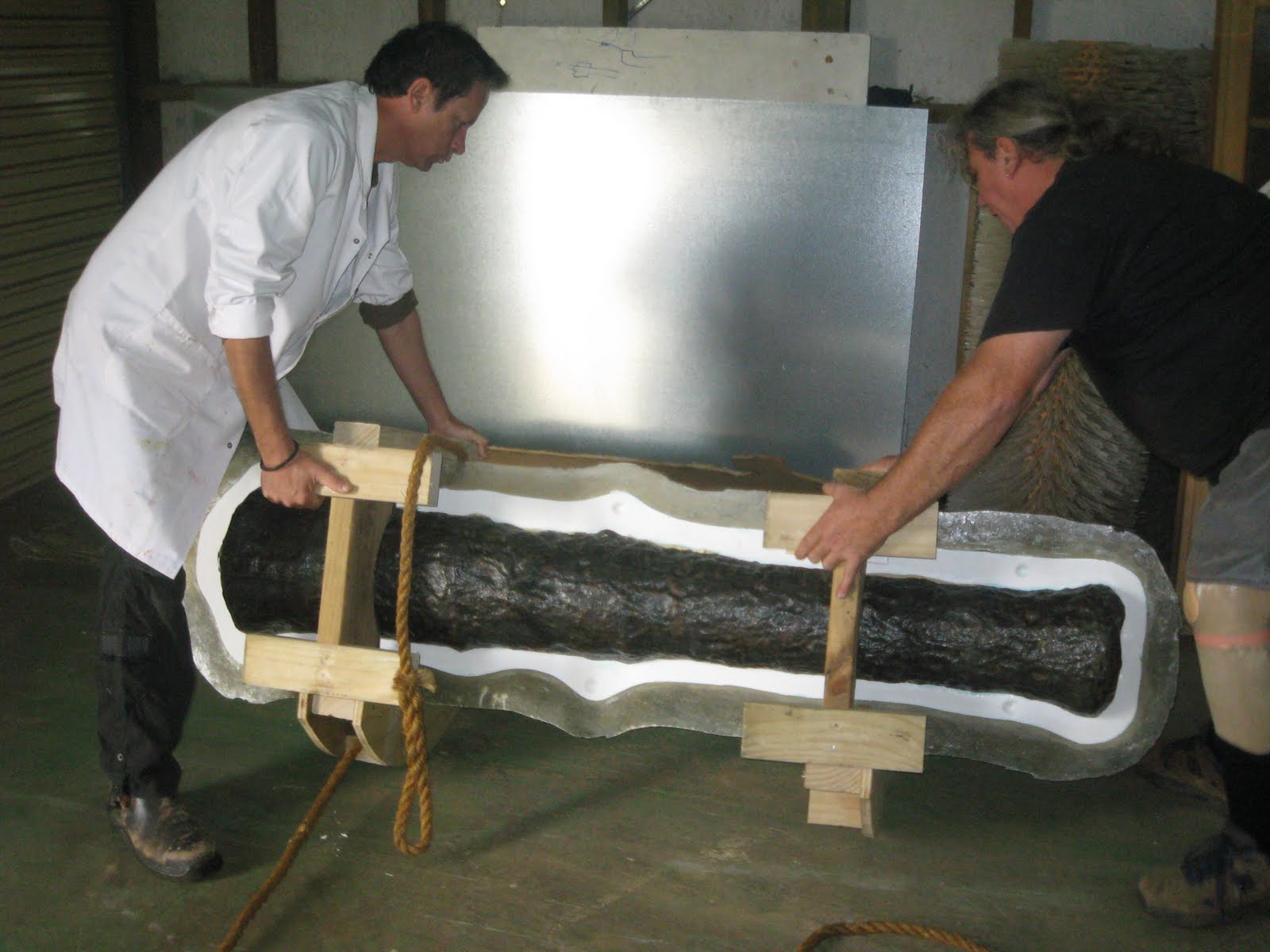
On Friday afternoon Phillip and Lee shook hands after finishing off all the fibre-glassing - they are working ahead of schedule. That meant that this morning they could begin trimming the edges off the fibreglass and pop off the fibre-glass shell. They then peeled back the silcone cover, turned the cannon over and the same procedure was repeated. The result is two perfect moulds ready for casting. The cannon was put back up onto a table ready for conservation work to begin after the cast has been made. 

Our photos tell the story - exciting progress!

Covered in fibre-glass with toggles on the top side


Prising off the fibre-glass


The fibre-glass comes off
The silicon gets peeled off


The silicon gets laid in the fibre-glass mould


The cannon gets turned over
The fibre-glass is removed


Two moulds ready for casting


The cannon gets put back on the table ready for conservation work

Wednesday, August 11, 2010

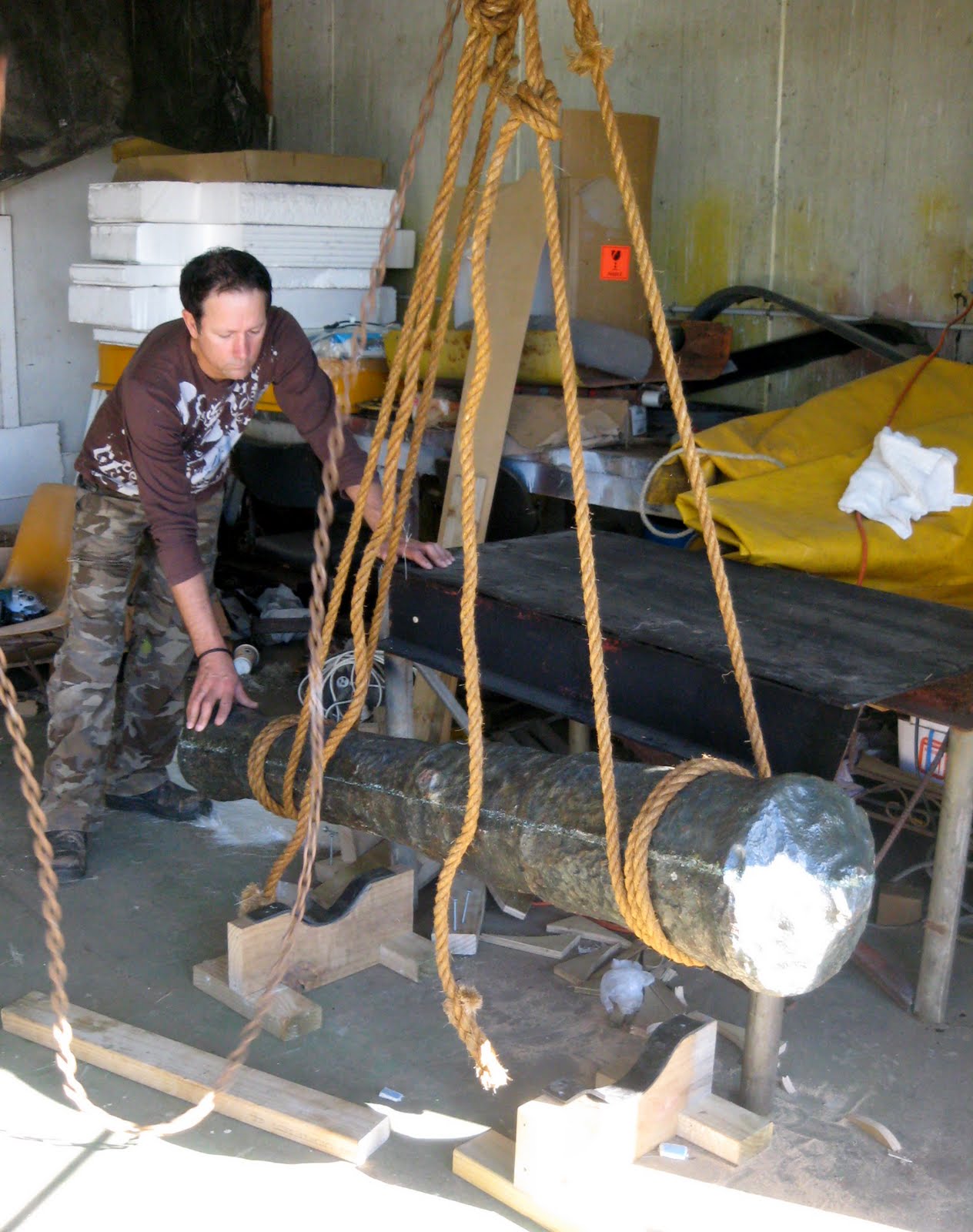
How to turn over a half tonne cannon

Our Bounty cannon has been transformed! One half of it has a layer of silicon topped with fibre glass and it has been turned over for the other side to now receive the same treatment. These are the steps in making a replica cast of the cannon.

With its silicon cover
Boxed up ready for turning
The work is being carried out by Phillip Smith from the Museum of Tropical Queensland as the first step in a conservation project on the cannon. The project has been funded by the National Libary through the Community Heritage Grants Program and after the replica has been made the cannon will have its coating removed, surface corrosion removed and may then be immersed into a tank of solution for a number of months.

Phillip is making a two part mould of our cannon from silicon and fibre glass. He started off work by making a timber cut out around the cannon which provided the barrier for making the two parts of the mould. A layer of silicon was then applied and then a layer of fibre glass. After all that had dried – the cannon was turned over for the other half to undergo the same process. Phillip is being assisted with his work by local Lee Irvine. As you can imagine plenty of thought needs to go into how to turn over a half tonne cannon. As you can see in the photos, Phillip and Lee managed the manouvere perfectly!

A public viewing of Phillip's work on the cannon will be held on Wednesday 18th August at 1.00pm at the Works Depot. Phillip will explain the moulding and casting procedure and also give an overview of the work he carries out for the Museum of Tropical Queensland. If you would like to attend this free event please register with the Museum on 23788.


Step one - lift the cannon
Step two - place it one the floor
Step three - roll it over


Step four - landed gently!

Wednesday, July 28, 2010

Bounty Cannon Conservation

If you happened to see a cannon travelling on the back of a truck through Burnt Pine the other day, don’t worry we are not readying ourselves for enemy invasion! The cannon is the Bounty cannon, and it was being taken to the Works Depot in readiness for conservation treatments about to begin in the next few weeks. It usually sits in the Pier Store Museum, one of the most important objects on display in our Pitcairn Norfolk Gallery.

Moving a half tonne cannon is not an easy proposition, particularly as it sits upstairs in the Pier Store. Once again we were able to call on the expertise (and muscle!) of the KAVHA Works team to move it for us. As you can see by our photos the first step involved six strong men lifting it onto a prepared crate, which was sitting on top of a forklift, just outside the small side door. The forklift was then lowered to ground level and the cannon was transferred onto the back of a truck and driven up to the Depot. Thanks to David Magri and the KAVHA team for their support in undertaking this delicate operation.

This cannon is one of four, four pounder cannons aboard the Bounty when she arrived at Pitcairn Island. It is a standard design Naval gun and was put onto the Bounty when she was refitted from May 1787, prior to sailing for Tenerife on 23rd December 1787. It would have been mounted on a wooden carriage. It is known from the diary of George Hunn Nobbs that this cannon and one other were raised in 1845. One was used to salute ships visiting Pitcairn until 1853 when an accidental firing killed the island’s Magistrate. There is no record as to wether this is the cannon that fired the fatal shot.

The cannon was brought to Norfolk in 1856 when the entire population of Pitcairn Island left to relocate to Norfolk Island. On Norfolk it stood for many years outside the Military Hospital in Kingston. In the mid 1970s it was included in conservation work carried out by the Western Australian Maritime Museum, and travelled to Perth for that treatment. After it was returned to Norfolk it was included in the newly established Maritime Museum when it opened in 1988.

One of our photos shows the cannon being unloaded from the back of a Hercules when it was returned from Western Australia in 1978. Many thanks to Di Adams for the photo – it shows her father Mack and his cousin Billie Pumpa unloading her.

The cannon is now in need of further conservation treatment. A 2006 report by Jon Carpenter and Richard Garcia from the Western Australian Museum says it “is showing signs of corrosion activity beneath its surface coating. The coating will have to be removed in order to re-treat the canon”. In addition, there is significant corrosion and delamination of the bore, which is uncoated. The conservation work has been funded by the National Library of Australia through the Community Heritage Grants scheme.