Showing posts with label Myra Stanbury. Show all posts

Tuesday, August 18, 2015

The Carronade’s Tampion

Earlier this year we announced that a tampion (or tompion) had been brought back to the island after being at the Department of Materials Conservation at the Western Australian Museum for twenty two years undergoing conservation.  This tampion had been discovered in one of the HMS Sirius carronades when it was recovered from the wreck site.   We are delighted to finally have this object on display in our HMS Sirius Museum in a special cabinet constructed by K.C. Industries.


Myra Stanbury, now an 'Honorary Research Associate' at the Western Australian Museum, was the Registrar during the expeditions to recover the Sirius material from the reef.  She travelled to Norfolk in March this year as a guest presenter for the ‘225th Anniversary of the wrecking of the HMS Sirius’, bringing with her the tampion.  She said “In the process of conserving the second carronade recovered from the Sirius wreck site a disc-shaped, lathe-turned wooden tampion (or tompion) was found in the muzzle of the gun. 

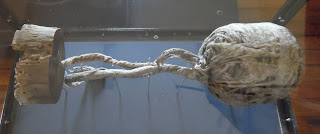
Made of maple (Acer sp.), the plug was designed to prevent the penetration of sea water into the bore of the muzzle-loading gun which could cause rust to develop and render the gun unserviceable. Sometimes the tampions were carefully sealed with tallow or putty to make them watertight. This appears to have been the method employed on the Sirius carronade as a ‘waxy-oily’ layer of material was removed from the machine-turned inner surface of the tampion before it was placed in a treatment solution to remove some of the reactive iron corrosion products.Attached to the inner side of the tampion was a lanyard consisting of two 34-cm lengths of twisted twine. This was spliced to a ball of string wadding that fitted snugly within the 131 mm bore of the gun. When loaded with a clean round shot to fit the gun the ball of wadding in the muzzle would prevent the displacement of the tampion by the impact of the round shot as it rolled back and forth in the barrel with every roll of the ship. In this way, sometimes helped by the addition of olive oil or other suitable lubricant into the chamber of the gun, the bore was kept in good condition while at sea”.

This tampion is a very significant object. Not only is it a very rare example of a complete tampion of this period, it is now displayed beside the carronade it was recovered from, and the carronade itself is rare for its early short barreled design –  and it is on display within several hundred metres of the site of its recovery.  Come to the HMS Sirius Museum and take a look for yourself, remember entry is free for residents.   (Our image shows the tampion on display.)


And last but not least, I want to say a huge thank you to two amazing people who have volunteered their time at the museum last week.  Some of you may know David and Michelle Cullen being regular visitors to the island, they have been working hard in the Guard House completing a huge task of sorting papers, creating files and entering data.  I think we’ve exhausted the island’s supply of manila folders.  Thank you, thank you …. and see you again next year.

Janelle Blucher


Sunday, March 29, 2015

No Ordinary Week!


Tampion removed from HMS Sirius carronade

With the museum being the home of the HMS Sirius collection and last Thursday being the 225th anniversary of her wrecking, this week was never going to be anything other than extra-ordinary! Planning for this day began well over a year ago and teaming up with the Norfolk Island Travel Centre (NITC) meant that Graeme Henderson and Myra Stanbury could be invited to join us from Western Australia as special guest presenters and a full week of events planned. The NITC brilliantly organised a very special week for the First Fleet descendants and others who travelled especially to mark this special anniversary. Visitor numbers exceeded expectations with over 200 people sitting down to lunch and presentations at the waterfront on the anniversary day. 

Myra Stanbury, Kandy Henderson, Graeme Henderson, Kalle Kasi
Graeme Henderson and Myra Stanbury were of course key personnel from the 1980s maritime archaeological expeditions to recover the Sirius’ artefacts that are now on display in the museum. Graeme led the expeditions and Myra was the Registrar. Their presentations underscored the importance of the Sirius (Graeme’s final presentation was titled: Australia’s most important shipwreck) and the story of the undertaking of the 1980s expeditions and their findings. In her final presentation Myra estimated that 50% of the people involved in the expeditions were local Norfolk Islanders. This week brought together the story of the ship and her wrecking, with the stories of the people who travelled on her final voyage or one of the other ships of the First Fleet, as so many of our visitors this week were their descendants.

The relationship the Norfolk Island Museum has had with the Western Australian Maritime Museum (WAMM) has continued from the time of the expeditions. In particular this has been via communication and support with the on-going conservation of the collection. A number of objects went to the Department of Materials Conservation at the Western Australian Museum for conservation and gradually returned to the island when their treatments were completed. Myra and her colleague from WAMM who also travelled to Norfolk for the week, Kalle Kasi brought with them one of the final objects that has been in treatment over the past 22 years. It was an absolute highlight for us to receive the tampion (or tompion) that had been found inside one of the carronades and display it for this week.
Drawing: Myra Stanbury

Myra has said about the tampion: “In the process of conserving the second carronade recovered from the Sirius wreck site a disc-shaped, lathe-turned wooden tampion (or tompion) was found in the muzzle of the gun. Made of maple (Acer sp.), the plug was designed to prevent the penetration of sea water into the bore of the muzzle-loading gun which could cause rust to develop and render the gun unserviceable. Sometimes the tampions were carefully sealed with tallow or putty to make them watertight. This appears to have been the method employed on the Sirius carronade as a ‘waxy-oily’ layer of material was removed from the machine-turned inner surface of the tampion before it was placed in a treatment solution to remove some of the reactive iron corrosion products.

Myra and Janelle Blucher
Attached to the inner side of the tampion was a lanyard consisting of two 34-cm lengths of twisted twine. This was spliced to a ball of string wadding that fitted snugly within the 131 mm bore of the gun. When loaded with a clean round shot to fit the gun the ball of wadding in the muzzle would prevent the displacement of the tampion by the impact of the round shot as it rolled back and forth in the barrel with every roll of the ship. In this way, sometimes helped by the addition of olive oil or other suitable lubricant into the chamber of the gun, the bore was kept in good condition while at sea”. 


Kalle, Myra and Janelle unpacking the tampion
The tampion is a very special object. Not only is it a very rare example of a complete tampion of this period, it will be displayed beside the carronade it was recovered from – which is on display within several hundreds of metres of the site where it was when the Sirius was wrecked. 

We have had an extraordinarily busy week at the museum. My sincere thanks to the team of Administration workers employed as our Museum Attendants who have worked so hard to ensure that all our visitors had an extraordinary experience on Norfolk Island this week. 

 Photo of the tampion being put on purpose made stand
 Photo of connecting the hemp wading rope

 Photo of maple plug

Sunday, August 10, 2014

A Very 'Sirius' Anniversary


The 19th of March next year will be the 225th anniversary of the wrecking of HMS Sirius on the reef at Norfolk Island. Her wrecking was undoubtedly the most serious event to occur during the early life of both the Port Jackson and Norfolk Island settlements and this important anniversary is one that we intent to mark. To do so we have teamed up with The Travel Centre to organise for a week of events that will include a luncheon on the 19th March under a marquee at Munna’s, timed to mark the Noon time wrecking.

However the most exciting news around this week is that the special guest presenters for these events are Graham Henderson and Myra Stanbury. Many locals know both Graham and Myra as they were the key personnel involved in the four 1980’s expeditions to recover the Sirius artefacts, now displayed in our HMS Sirius Museum. Graham led each expedition and Myra was the Registrar. Graham is recently retired from the Western Australian Maritime Museum where he was the Foundation Director, and Myra still works there as a Senior Curator. They are co-authors of ‘The Sirius: Past and Present”, a comprehensive book on the Sirius’ history and archaeology. Together they are two of Australia’s most eminent maritime archaeologists and we are very excited that they have agreed to be on-island for this special event.
 
Graham Henderson
 In addition to presentations on the anniversary day of the wrecking, Graeme and Myra will speak at the Welcome dinner, an HMS Sirius Research Presentation and other maritime themed events. No doubt we will hear many stories from the four expeditions they worked on between 1983 and 1988 which resulted in the raising of approximately 3,000 artefacts including a 1.7 tonne anchor, carronades, ballast, cannon balls, scientific equipment and fine pieces from the Officer’s Cabin. There were many locals who also took part in the dives and expeditions so the week will no doubt have a reunion event planned. We would appreciate any help that you can provide in spreading the word about the week to those involved, please call in to the Pier Store or phone us on 23788 if you’d like information sent on to contacts on the mainland.


Myra Stanbury
This week will of course not only be of interest to those with a maritime interest, but those who ancestry goes back to the First Fleet. Directly involved were those on the Sirius and also the Supply. At the time of her wrecking the Sirius was on a desperate mission sailing to Canton, China to purchase supplies as the Port Jackson population was on the verge of starvation and existing on half rations. On the first leg of the journey she was accompanied by the Supply to transport 116 convict men, 67 convict women, 27 children and 65 marines to Norfolk – thereby offloading their ‘feeding burden’ from NSW to the Norfolk Island settlement. It was while both ships were unloading supplies at Kingston that the wrecking occurred.

However as it impacted on everyone in the Colony at that time, this event will be of interest to descendants of those on the two ships, the existing population on Norfolk Island and also all those in Port Jackson. This was psychologically ‘their’ ship – the flagship of their First Fleet voyage, their lifeline back to mother England and the ship they put all reliance on. As Governor Arthur Phillip said when news of the wrecking reached him in Port Jackson: “You never saw such dismay as the news of the wreck occasioned amongst us all; for, to use a sea term, we looked upon her as our sheet anchor”.

We’d love any help you can give us to publicise this important event and the week of planned activities organised to mark it. Details can be found on The Travel Centre’s web site at www.norfolkislandtravelcentre.com/events/anniversary-of-the-wrecking-of-the-hms-sirius or call us on 23788 for further information.