Monday, September 7, 2015

Pictures from the past


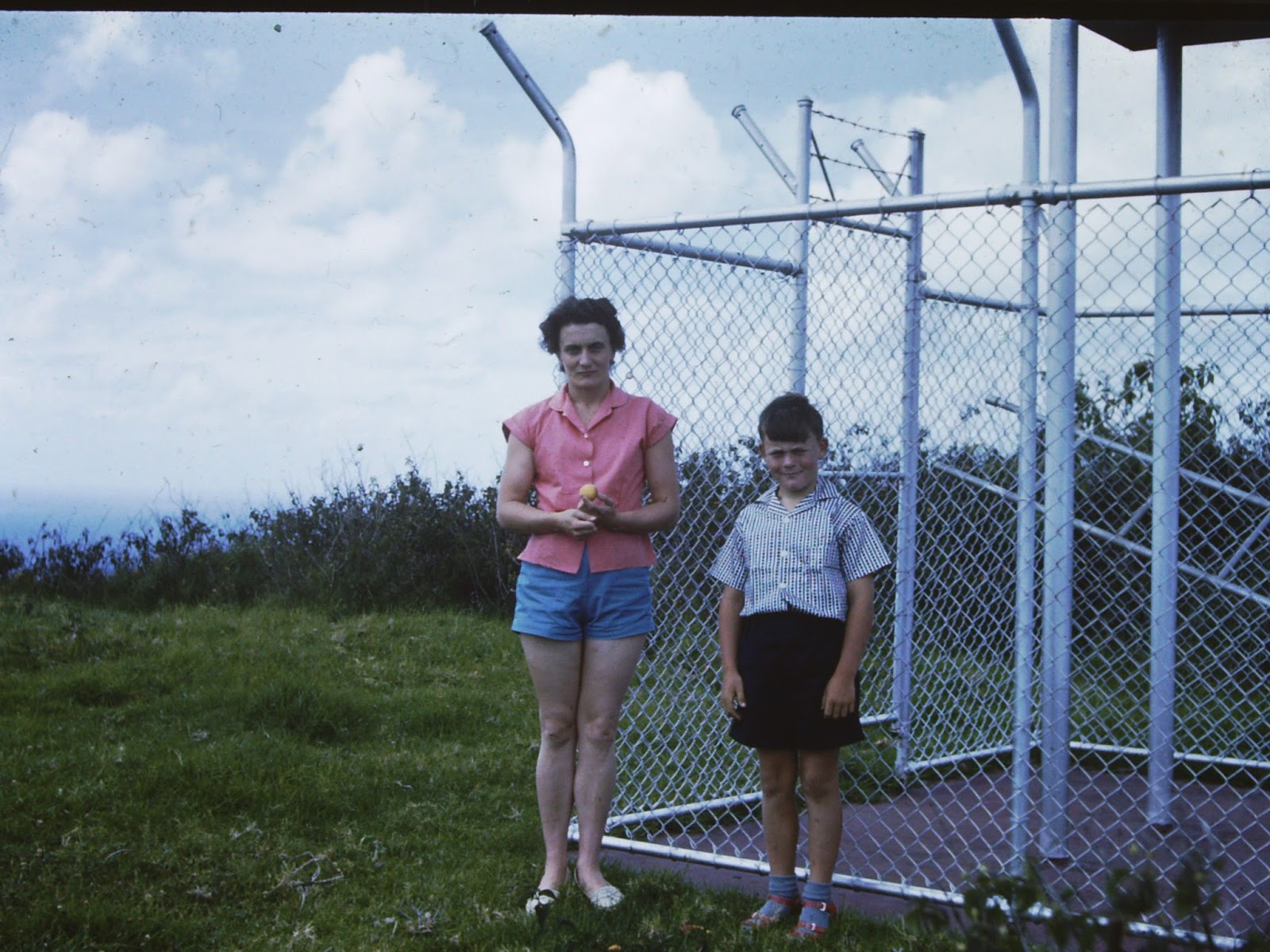
Robert Finlay and his wife Jeanette visited the Norfolk Island Museum last week. Robert came to Norfolk Island for a holiday in February/March 1959 with his mother Mrs Beverley Finlay, from Launceston, Tasmania to visit his uncle and aunt who were living on the island at the time.  Mr Frank Patrick, his uncle, was the Officer in Charge of the airport, and Mrs Patrick was Robert’s mother’s sister.

Robert found some slides which belonged to his mother from that era, and brought the images with him to show us at the museum.

They include photos of the ‘NI’ pines at the airport; the airport lounge before and after upgrade; Joy Cochrane nee Christian pictured with Robert on horseback; the Burns Philp store at Middlegate; a church picnic at Kingston; views of Kingston prior to the pine plantings; view of Kingston from Rooty Hill Road; Burnt Pine shops; Hopkins store; Philip Island; views from Mt Pitt; airport office; the OIC house at DCA circle; the fire engines and a number of others.

Thank you Robert for so generously sharing your photos.


Monday, August 31, 2015

MMAPSS Success


We are delighted to have received notification from the Maritime Museums of Australia Project Support Scheme (MMAPSS) of our successful grant application to undertake the ‘HMS Sirius Collection Condition Assessment 2015’ project. 
Established in 1995 MMAPSS provides funding to support Australia’s maritime heritage. It is jointly funded by the Australian Government and the Australian National Maritime Museum (ANMM).  The Norfolk Island Museum has been extremely fortunate to have been the recipient of numerous grants over the years; grants that have assisted us in caring for the HMS Sirius Collection and funded the research, conservation, care and display of various aspects of Norfolk Island’s maritime heritage.

Carronades
This year’s project provides for a conservator from the ANMM to visit Norfolk Island to conduct an assessment of the condition of the HMS Sirius Collection, the proposed date for the visit is February 2016.  In 2012 the collection was relocated from the Pier Store Museum into a dedicated HMS Sirius Museum, this is in the old Protestant Chapel or the Prince Phillip Youth Centre as some of us will remember.  This dedicated museum offers better environmental conditions than the Pier Store.  The collection is continuously monitored by the museum staff and preventive conservation is applied to ensure it remains stable in the new environment. 
However, it is seven years since a qualified conservator has undertaken a whole of collection condition assessment.  In this time not only the collection on display has been exposed to movement and a fluctuating environment, but the collection in storage has been rehoused into micro-environments.  This amount of changing activity to the collection now requires an assessment to record its condition. It is hoped the assessment will record the collection is in a good condition due to the environmental improvements over this time.  
Sirius artefacts raised from the seabed

Janelle Blucher


Tuesday, August 25, 2015

Volunteers come at the right price. They are priceless!


It has been an extremely busy and productive past couple of weeks at the museum as we have benefited from the valuable skills and time offered by two wonderful volunteers.  Sue and Don Brian are not strangers to Norfolk; they left the island eighteen months ago after living here for five years.  Don taught science and chemistry at NICS and Sue volunteered her time to the museum four days a week for the most of that time, Sue had to have Wednesdays off from the museum so she could attend to weaving with the guys at the Golden Orb, and if she wasn’t at either of those places, you could find her volunteering for the National Park.  Outside of these times they were involved in many other charitable activities supporting the island. 
What they have achieved for the museum these past two weeks is just remarkable.   
 

Sue developed a template that enables us to upload multiple entries into our database in one single upload.  This is no mean feat considering there are more than eighty fields and multiple layers of classifications necessary for the cataloguing.   This template has enabled us to finally upload the Les Brown Collection of over 1,000 files, plus books and images into our database.  This week Sue has uploaded more than 2,000 entries into our database.    Sue’s previous volunteer work with the museum was mainly in the field of conservation, with a science background, she was perfect for the job, this week she has been able to provide instruction in conservation techniques to Gaye Evans, who has recently joined us at the museum.
Don originally planned for a one week holiday and extended to two.  He was kept busy for the first week digitising our entire collection of cassette tape recordings.  This digitising work is done in ‘real time’, outsourcing for this project would have cost hundreds.  Amongst this collection of cassette tapes is a recent donation by Chris Nobbs including nineteen oral history interviews he conducted during the 1980s and ‘90s, now we can hear those voices and listen to those stories.
Both Sue and Don have been enthusiastic researchers of everything ‘Norfolk’ even after they left the island, Don has taken on many interesting research projects himself and Sue has recently focused her research time on the shipwrecks of Norfolk, this research can now be seen on the Australian National Shipwreck Database, you can access it at www.environment.gov.au/topics/heritage/historic-shipwrecks/australian-national-shipwreck-database.
The final day of their ‘holiday’ on Norfolk was taken up with performing the next step in the conservation of the artefacts recently recovered from the works in the Blacksmith’s Compound.  More than one hundred ferrous objects were brushed and then placed back into fresh solutions of 2% sodium hydroxide; this part of the conservation process is to remove the corrosion causing chloride from the objects.  Sue’s work on the cataloguing template will be greatly appreciated again when it comes time to record these items into our database. 
These are the major projects accomplished during their two weeks on island, there were many other tasks completed along the way.  Sue and Don, your generosity and achievements are immeasurable, a huge thank-you to you both from a truly grateful Norfolk Island Museum.  Come back soon ..okay!


Tuesday, August 18, 2015

The Carronade’s Tampion

Earlier this year we announced that a tampion (or tompion) had been brought back to the island after being at the Department of Materials Conservation at the Western Australian Museum for twenty two years undergoing conservation.  This tampion had been discovered in one of the HMS Sirius carronades when it was recovered from the wreck site.   We are delighted to finally have this object on display in our HMS Sirius Museum in a special cabinet constructed by K.C. Industries.


Myra Stanbury, now an 'Honorary Research Associate' at the Western Australian Museum, was the Registrar during the expeditions to recover the Sirius material from the reef.  She travelled to Norfolk in March this year as a guest presenter for the ‘225th Anniversary of the wrecking of the HMS Sirius’, bringing with her the tampion.  She said “In the process of conserving the second carronade recovered from the Sirius wreck site a disc-shaped, lathe-turned wooden tampion (or tompion) was found in the muzzle of the gun. 

Made of maple (Acer sp.), the plug was designed to prevent the penetration of sea water into the bore of the muzzle-loading gun which could cause rust to develop and render the gun unserviceable. Sometimes the tampions were carefully sealed with tallow or putty to make them watertight. This appears to have been the method employed on the Sirius carronade as a ‘waxy-oily’ layer of material was removed from the machine-turned inner surface of the tampion before it was placed in a treatment solution to remove some of the reactive iron corrosion products.Attached to the inner side of the tampion was a lanyard consisting of two 34-cm lengths of twisted twine. This was spliced to a ball of string wadding that fitted snugly within the 131 mm bore of the gun. When loaded with a clean round shot to fit the gun the ball of wadding in the muzzle would prevent the displacement of the tampion by the impact of the round shot as it rolled back and forth in the barrel with every roll of the ship. In this way, sometimes helped by the addition of olive oil or other suitable lubricant into the chamber of the gun, the bore was kept in good condition while at sea”.

This tampion is a very significant object. Not only is it a very rare example of a complete tampion of this period, it is now displayed beside the carronade it was recovered from, and the carronade itself is rare for its early short barreled design –  and it is on display within several hundred metres of the site of its recovery.  Come to the HMS Sirius Museum and take a look for yourself, remember entry is free for residents.   (Our image shows the tampion on display.)


And last but not least, I want to say a huge thank you to two amazing people who have volunteered their time at the museum last week.  Some of you may know David and Michelle Cullen being regular visitors to the island, they have been working hard in the Guard House completing a huge task of sorting papers, creating files and entering data.  I think we’ve exhausted the island’s supply of manila folders.  Thank you, thank you …. and see you again next year.

Janelle Blucher


Tuesday, August 11, 2015

Touching History


This is exactly what 8th generation First Fleeter descendant Andre Forrester did in our museum this week, touched a tangible connection to the history of his forefather.

‘Do not touch’ is a general rule in our museums, particularly when it comes to metal, the moisture, oils and salts on your skin transfer to the object encouraging corrosion.  However, this particular metal object has a sign beside it which reads ‘please touch’.   This object is a ballast block recovered from the wreck of the HMS Sirius during the ‘2002 Sirius Expedition’ the fifth and the last maritime archaeological expedition conducted on the wreck site of this flagship of the First Fleet.  

This iron ballast block has a long conservation story. For many years it has been immersed in a caustic solution undergoing an electrolytic reduction process to remove the chlorides from the metal.  This took multiple changes of more than 120 litres of solution, rinsing and maneuvering of a block weighing in at approximately 100 kg, hundreds of chloride readings and plenty of patience.  Then it was necessary to remove the remaining accretions cemented onto the block, and finally it was ready for applications of rust converters and waxing.  It is these applications and layers of wax that is providing the protective coating that enables it to be ‘touched’.   To list the names of the people that have supported the Norfolk Island Museum with the conservation of this object over so many years, are too many.  However, we’d like to say thanks to Shane McCoy from the Administration Works Depot for his recent work on the final stages and preparation for display.

This is a wonderful addition to our HMS Sirius Museum, housing the most extensive collection of cultural material from the First Fleet.  The First Fleet consisted of eleven ships, nine of these were privately owned and two British naval ships, carrying over 1400 people they left Portsmouth in May 1787 to arrive at Port Jackson in January 1788, these people are the founders of modern Australia.


Andre’s ancestor Robert Forrester was a convict in the First Fleet, making his voyage to Australia on one of the privately owned ships, the Scarborough.  Originally sentenced to death at the Old Bailey for stealing six guineas in gold with a couple of other characters, his sentence was later reprieved to 7 years transportation.  Robert came to live on Norfolk Island between the years of 1791 and 1793 holding a grant of 12 acres at Mount Pitt Path in Queenborough.  Robert Forrester’s descendants have come back to Norfolk to make it their home.  It was an honour to ask Robert Forrester’s descendant Andre to be the first First Fleeter descendant to ‘touch’ this link to his history.

Janelle Blucher


Sunday, June 28, 2015

The Blacksmith's Shop


Douglas Hobbs, Senior Archaeologist


“I think we’ve found something” was the comment heard in the Blacksmith’s Compound in Kingston last Saturday morning which created a scene of excitement.  The floor in this compound, currently used by the KAVHA works team, is being stabilised to prevent flooding and improve drainage.  Scraping away just fifteen centimetres of the surface dirt revealed two pits containing charcoal, leg irons, horse shoes, chain links, nails, wall fasteners and obvious ‘smithy’ waste or slag.

The first pit showing artefacts uncovered
 Built in 1846 the original buildings and yard were surrounded by a stone wall with an entrance gate in the north wall.  The smiths were housed in a stone structure against the south wall of the yard; there were four blacksmith forges and one nailors forge.  Other shops or work sheds were built against the side walls, all of these original buildings fell into disrepair during the 1880’s.  Both pits discovered last weekend were located towards the southern wall of the compound indicating they may have been associated with the blacksmiths forges.  They were somewhat conical in shape, less than one metre in diameter with a depth of approximately twenty centimetres defined by sand, dirt and crushed calcaranite bedding.


Norfolk Island Museum Tagalong Tour witness the discovery


 Most smiths burned charcoal in their forges because it was easy to light, burned hotter and cleaner than wood and was readily available, particularly on Norfolk Island.  A method for producing charcoal involved a pit kiln process where wood was slowly burned in a shallow pit covered with soil.  As these pits were full of charcoal, maybe they were used for making the charcoal to fuel the forges.  Much speculation and suggestions were offered to determine what these pits were actually used for, even our museum tour made a diversion to the site to join in the discussion.  One suggestion was they were the smithy’s waste pits, this begs the question of why was there such a substantial amount of intact and complete objects located in them.  Senior Archaeological Consultant, Douglas Hobbs is on island to oversee the works, Doug has over 43 years of experience in discoveries and archaeological research. Leave it to the expert to answer those questions for us!

The immediate concern for the Norfolk Island Museum is to stabilise the one hundred or so objects recovered from these pits.  Once removed from their anaerobic salty dirty environment after more than 150 years, instant deterioration begins to occur.  A desiccated or dry environment is the first aid for these objects until we are ready to take on the job of cleaning, brushing and rinsing.  Once you begin this process you can’t stop.  The objects then require immersion in an alkaline solution to draw out the chlorides.  This process can take months involving solution changes and chloride readings.  Once these readings deem the object free from salt they will be rinsed to remove the alkaline residue and slowly dewatered.  The final stages include application of a rust convertor followed by a sealant to act as an environment barrier.  Then this fantastic addition to our collection will be ready for interpretation, display and research.

Just to finish off, it is interesting to read a diary entry of Thomas Samuel Stewart, Commissariat Storekeeper and caretaker on the island during the time between the penal settlement in 1855 and the arrival of the Pitcairners in 1856 as it relates to some of these recent finds in the Blacksmith’s compound.

July 4 Wednesday – And Farrell employed casting turf to cover a small kiln of Wood that was being built when the ships arrived with the news that all the Engineer property left on the Island was to be handed to the Commissariat.  I spoke to Mr Walker previous to his leaving I think about a fortnight, on the propriety of having some Horse Shoes made, in readiness in case of need – and he, very considerately, ordered Constable Kelly that was the Horse Shoe maker on the Island at the time to make a few sets.  I saw Kelly a few days before the ships sailed and enquired of him.  If he had mad the Horse Shoes? (I knowing he had been told off for this duty.) He told me he had made more that he thought would be required.  But all that I have found is a few old worn out shoes lying in [the] shed at the Black Smith’s shop.  What the man could have been doing for the time he should have been making these shoes, is what I cannot tell, but I am afraid, it must have been for the want of fuel.  And as there is not a bit to fit a shoe on a horse, and Field has used all that is able to be put on, unless altered, I must endeavour to burn off this kiln, and have set Farrell to this work

Stewart follows this with later entries stating that he acted as the blacksmith when there was no other on the island.  These diary entries really highlight the importance of this skill on the island during that time.  

Janelle Blucher

From one Rock to another ...


 The Morayshire off Norfolk Island 8 June 1856


The Morayshire arrived at Norfolk Island amid squalls of rain and strong winds, on board were the exhausted and seasick Pitcairners having travelled some five thousand kilometres from one island home to another. Coming ashore after five weeks at sea, with mixed emotions, wet and unsettled, they were met by Thomas Samuel Stewart, the Commissariat Storekeeper, his wife Isabella and Captain Denham of the HMS Herald.  Mr and Mrs Stewart and a small group of people had remained on the island since the closure of the penal settlement in 1855.  Captain Denham of the HMS Herald had been sent to Norfolk Island to assist with their arrival.

Because of the conditions a wait of two days was required before they could come ashore. Viewed from the ship, the island’s general appearance disappointed them as George Hunn Nobbs records: “…very much disappointed with its appearance from the present point of view…Every face wore an expression of disappointment…No doubt other parts have a better appearance, but this side certainly bears no comparison with our Rock in the West”.  No doubt tiredness and exhaustion sullied their view, and what would have been more, an overwhelming realisation that Pitcairn their home, their ‘rock of the west”, was now in the past.  Adding to this view, the Kingston area was almost denuded of trees, when on shore Nobbs states “There is scarcely a tree in sight from the settlement, except some dozen or two of pines planted near the Government House”.

Come this time, the Reverend George Hunn Nobbs, their leader and pastor for more than 25 years, had to convince the people that to quit Pitcairn was not only necessary as the island was too small for their growing population, but also that it would be for their ultimate benefit.  He avowed “Her Majesty’s most gracious offer, to wit, Norfolk Island and all that appertains thereto, for ourselves and families…Such an unqualified offer of so beautiful a spot on Norfolk Island, is easier to imagine than realise; but is a Bona Fide reality to us.”

Sarah Nobbs, grand daughter of Fletcher Christian and Mauatua, was married to the Reverend George Hunn Nobbs, she writes:
“After a passage of five weeks we arrived here, and landed on Sunday June 8th, amid squalls of rain, which thoroughly drenched us: but Capt. Denham who was here, had fires prepared and tea ready for us, so that we soon got as comfortable as we could possibly be, in to us such a bewildering place. Everything was so strange; the immense houses, the herds of cattle grazing, and in the distance the gigantic Norfolk pines filled us for the moment with amazement. I was conducted by Mr Stewar[t] to the Government House, and seated by a good fire in the drawing room (I have learned that name since), which was the first fire I had ever seen in a dwelling house, and an excellent addition to my previous ideas of domestic comfort…”.

This day of arrival at Norfolk Island was Sunday, 8th June 1856. That same evening the Pitcairners held their usual Sunday service in the large upper room of the old military barracks, where the Norfolk Island Government’s Assembly Chamber and Committee Room is today.  They gave thanks to God for their preservation and asked for guidance in this new era they had just entered upon.

The arrival of the Pitcairn Islanders to Norfolk Island is celebrated every year as Anniversary Day, often referred to as Bounty Day. In the early years after their arrival the day was commemorated with a simple church service. Over the years it has evolved to a full day’s celebration beginning with a march from Kingston Pier to the Cemetery.

The first march began with only the men with surnames of the Bounty mutineers dressed in sailor suits. The women joined in soon after and then the ‘All comers’ - those with the surname Nobbs, Buffett or Evans. In later years those who have married into island families march as well.

Up until the late 1930s a wooden structure was erected on the cricket ground in Quality Row to represent the Quarter-deck of the Bounty. The Union Jack was flown and the Bounty cannon installed on the deck was fired, often with the help of fire crackers. God Save the Queen and Rule Britannia were sung with gusto.

Revived in the 1950s after an absence of marching during WWII, the march came to include a re-enactment of the landing at Kingston Pier, a march to the cenotaph and along Quality Row to the cemetery. Here, the Islanders recite ‘John Adams Prayer and while singing ‘In the Sweet Bye and Bye’ children lay wreaths on the graves of their ancestors. The Lord’s Prayer is read and the Pitcairn Anthem is sung.  Since 1947 a morning tea at Government house concluded the morning’s activities.

A large community picnic is the next event for the day. While today it is held in the Compound it has been held against the gaol wall overlooking the Common, in the grounds of the New and Old Military Barracks, in Pound Paddock and the old and current Rawson Hall (the wet weather option). The singing of Grace always precedes the picnic. Tables are laden with traditional island food including roast meats, pilhi, mudda, hihi pie, fish, sweet tatey and sweet island pies, usually served with cream, otherwise known as ‘Norfolk gravy’.  Lunch may be followed by a cricket match between the islanders and the all comers.  The day concludes with the Bounty Ball in Rawson Hall. Then all dem tired lettle sullen are taken home to bed. 

Happy Anniversary Day from all ucklun at the museum down a town.  8 June 2015