Showing posts with label cargo. Show all posts

Tuesday, January 19, 2016

Building the hull


Note: This post continues from earlier Attaching the clamps to the clinker


Progress on the Lighter is clearly seen from the number of clinkers that have been added to the Lighter. The bow rises toward the keel and the shape of the hull is widening.


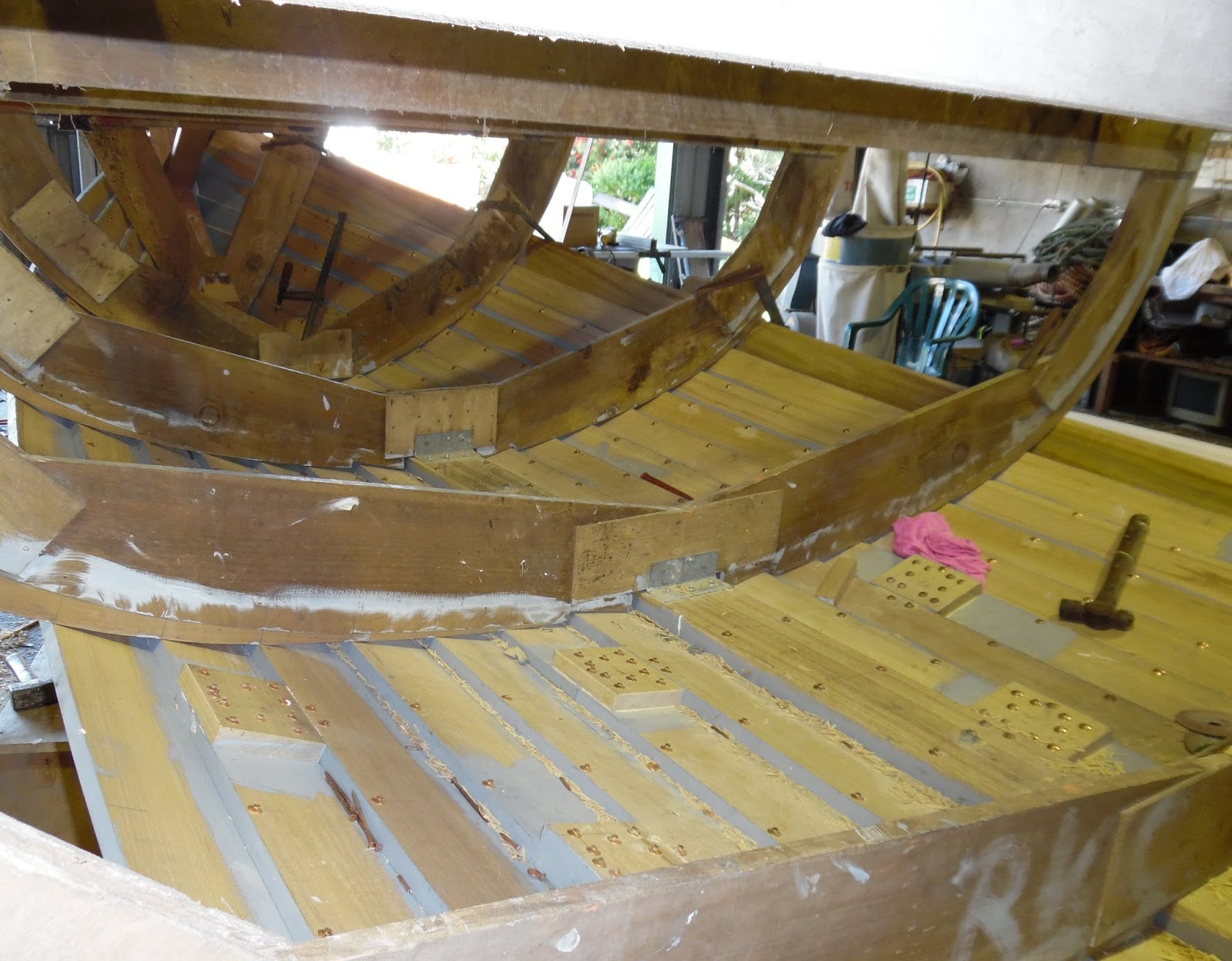
Inside the hull, beside the clamps, are some of the 4,000 copper nails which will be used.
When placed, the clinkers are staggered to allow distance between the joins.
A frontal view from bow to stern.
A left hand view from stern to bow.


 Regular posts on the building of the lighter will be uploaded to this blog.


Wednesday, December 16, 2015

Steady progression of work on the Lighter


Note: This post continues from earlier Norfolk Island Lighter

Work steadily progresses on the building of the Norfolk Island Administration’s new lighter. The lighters carry cargo from ship to shore and are an important part of Norfolk Island’s infrastructure. Building commenced in late August.
Right hand profile - bow to stern
Left hand profile - bow to stern
Left hand profile - stern to bow
Carvel planking, the traditional method where planks are affixed edge to edge, is clearly shown

Regular posts on the building of the lighter will be uploaded to this blog.

Sunday, December 6, 2015

Norfolk Island Lighter


Note: This post continues from earlier Salvage and Restoration

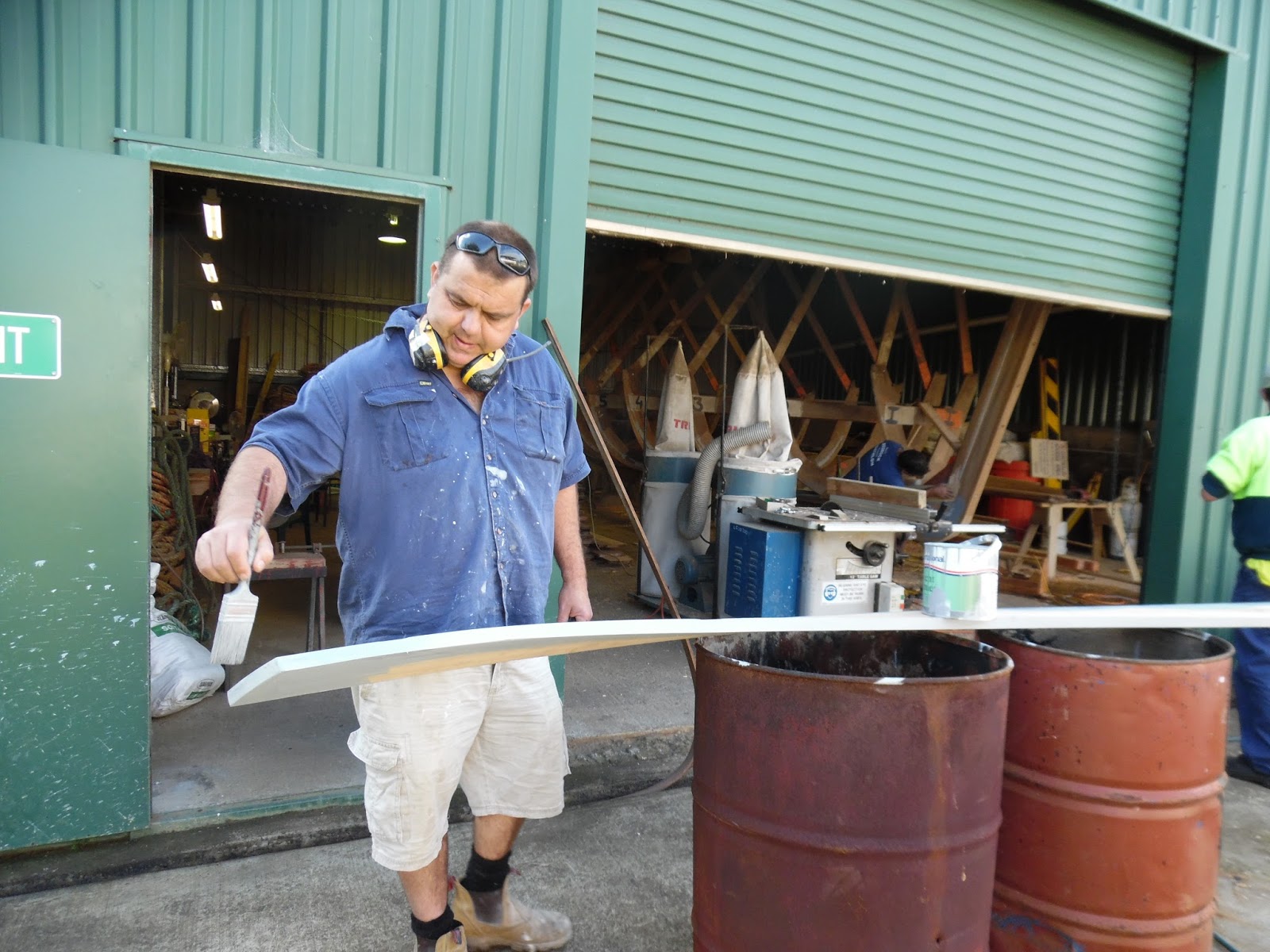
A visit to the Lighterage Depot sees Dean Burrell fitting the second carvel, the fastening of planks edge to edge, gaining support from the frame and forming a smooth surface.

                                    
 The keel is again chiseled by hand to ensure an accurate fit of the plank.


 Chiselling, planing, sanding - each step is meticulously carried out.


Once the plank is removed from the steamer and moulded to the frame, Dean then completes the laborious task of fitting it to the lighter.
When the carvel is secured in place, it is again inspected to ensure absolute accuracy.

These steps will be repeated again and again, as the lighter project progresses.

 
Regular posts on the building of the lighter will be uploaded to this blog.

Thursday, November 12, 2015

Steaming and Malleability

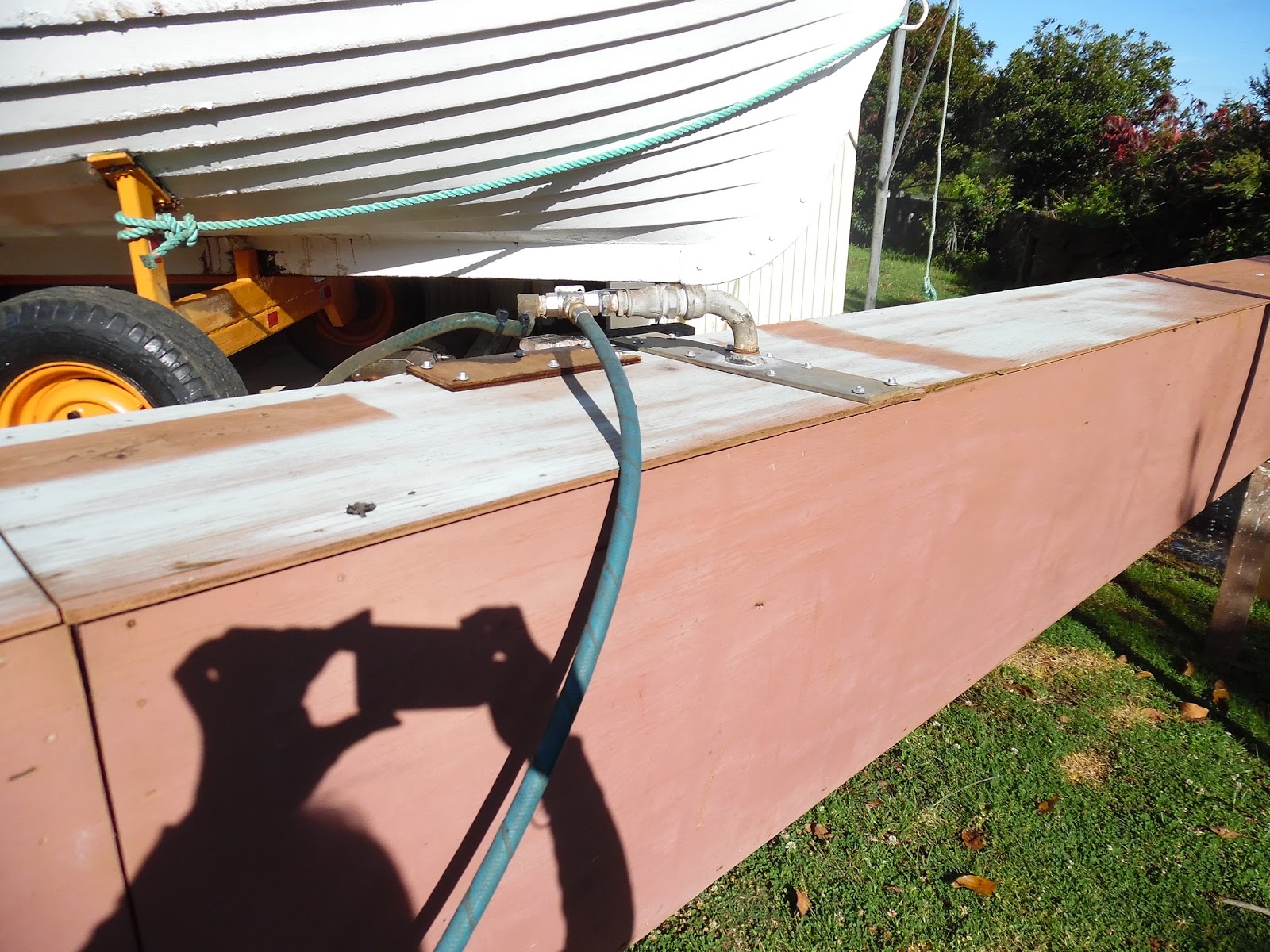
The planks for the clinkers and carvels are fitted, removed and shaped with chisels, then softened to enable them to be moulded to the curvature of the lighter from bow to stern. This is done by enclosing each plank into a steamer - a metal box with an attachment through which an engine pumps steam onto the plank. The wood softens as the steam heats the fibres. After several hours the plank is removed and again fitted to the hull, moulded and clamped to the frame. Once cooled and the shape is assured it is again removed and undercoat is applied to each plank before it is finally attached to the frame, glued, hammered and clamped into place.


 The steamer is located in the yard outside.
 
 One or two planks are placed inside.

 The engine is checked and turned on... 


 to send boiling water to the steamer through an attachment on the top.
  
 Steam slowly rises from the steamer ...

 ...and builds in volume as the hours pass.
 
The softened plank is then carried inside ...
 

 ... and again fitted to the lighter.  Note the steam rising from the wood.

 
 After fitting and cooling the plank is again removed ...
 ... and undercoat is applied to each piece prior to final placement.

Regular posts on the building of the lighter will be uploaded to this blog.
Thursday, November 5, 2015

Timbers and Planking


Work on the building of a new lighter continues at the Lighterage Depot with strengthening of the keel as timber is shaped and fitted with accuracy and skill.


Glen Williams recalled “..…as soon as Howard [Christian] heard that No. 01 had been burnt he came up and said “Hau mach stik yorlye niid? Wael ai el ran naeda twenti soe yu gat et fe speya”.  (How much timber will you need? Well I’ll run another twenty so that you have some to spare).     


 Howard Christian milled the timber from Norfolk Island pine and delivered it to the boatshed.


Glen Williams and Bevon Nicolai stacked and flitched the planks so that all materials were conveniently gathered on site when Dean Burrell commenced work on the lighter.

Regular posts on the building of the lighter will be uploaded to this blog.

Tuesday, November 3, 2015

Progress on the building of the new Lighter


The building of a new lighter - used to unload the cargo ships which visit Norfolk Island - has already commenced and photos were uploaded last week. Work progresses steadily and the frames which hung loosely from the ceiling are now connected to the hull. 

The outline of the lighter is clearly discernible.
The frame viewed from the left hand side; from the front and
and right hand side.

It is now time to attach the clinkers. The lighters display the overlapping planks that characterise clinker construction, a method used by experienced and skilled boat builders. The technique developed in Germanic shipbuilding tradition and is a trademark of Nordic navigation, particularly of the Viking longships. The oldest preserved clinker-built boat dates circa 320 AD. The planks overlap rather than butting each other. The planks are fastened with rivets, clench nails or glue where they overlap, resulting in a hull of considerable strength. A tight fit between planks is usually sufficient to keep the Lighter watertight, however sealants or glue is used.  Repairs are not as simple with clinkers as on carvel hulls due to overlapping planks and because the fit of the planks is more critical. 

The keel is chiseled out by hand prior to placement of the clinker.


 Once accurate placement is assured the clinker is glued and;

 hammered into place.

Hand chiseling to ensure accuracy whilst fitting the clinker in place, and also for placement of the next clinker.
 

 Accurate fit of the clinkers is important to the overall strength of the hull.


The men are satisfied with the first clinker and will now move to the stern of the lighter and repeat the process.


Regular posts on the building of the lighter will be uploaded to this blog.

Wednesday, October 28, 2015

Norfolk Island Lighters 2015


Norfolk Islander's continue the traditional methods for unloading freight from cargo ships.  The island has no 'safe harbour', there are two jetties on opposite sides of the island for the cargo to be landed.  The 'lighterage' method involves a lighter towed by a motor launch to ferry the goods between ship and shore.  A derrick crane and nets are used to lift and move the cargo in and out of the lighters. 

Sea freight was the only method of importing items to Norfolk Island until the building of the airport by American and New Zealand servicemen in 1945. Commercial flights began in 1947 and the opportunity to import items by air freight shortly thereafter, but to this day over 90% of imported goods are transported by two cargo ships which visit the island on a once every five week schedule.

In the early hours of Saturday morning 11 May 2013 a senseless act of vandalism happened on  Cascade Pier when lighter No.1 was deliberately set on fire. Not only was the lighter completely destroyed but also the island’s supply of cargo nets and the spreader beams used for transporting cars and trucks on the lighters when they were lashed together for this purpose.


The long awaited decision was finally given for work to commence on the building of a replacement lighter. Work began immediately by John Christian-Bailey of JCB and Dean Burrell, an experienced boat builder, under the watchful eye of the Lighterage Manager, Glen Williams.


In its lifetime, a lighter earns approximately $2.2 million in revenue for the island and carries approximately 30,000 tonnes. It takes four months to build from start to finish, 4,000 thousand copper nails to hold it together and is in use for up to twenty years. It is a practical object; a work of art and a legacy to the men who are building it. 

Peter Horrocks, of the Museum Trust, moved that the building of the lighter be photographically recorded for inclusion in the Norfolk Island Museum Collection.


Janelle Blucher, A/g Director Curator and Gaye Evans, Asst. Curator/Conservation Officer visited the Lighterage Maintenance Depot at Middlegate and spoke with the Manager of Lighterage, Glen ‘Snoop’ Williams and Dean Burrell, local shipbuilder. The frames hang vertically from the ceiling until such time as they are needed.


The plank for the keel has been carefully chosen and placed into position.


Work on the bowstem has commenced. This must be strong enough to endure the years of toil the lighter will give to the Island whilst ferrying cargo.

 Regular posts on the building of the lighter will be uploaded to this blog.